In Florence I photographed the Ponte Vecchio from a bridge, and the Leica Q3 43 at f/2.0 gave me some amazing shots with great depth of field. I didn't own the XCD 25V yet, and I regretted not having a fast short lens on the X2D II. Not that I minded using the Leica (it's an amazing camera with an astounding lens), but I would have liked to shoot that scene at f/2.5 on the 25V.
I own the 25V now, and I've since run it through a diffraction test. A reader on Reddit, replying to the diffraction test, asked what I actually set in the field.
This is what I typically set. It's my practice on one camera and three lenses, the XCD 25V, 55V and 90V, with a number behind each choice that you can check.
Key finding: Most of my X2D II scenes end up at f/8. With a close foreground on the 25V I focus stack at f/8, and shoot one frame at f/11 only when a stack won't work. Wind sets the shutter before the aperture, water gets an ND filter, and f/22 and f/32 never get set.
| Scene | Lens | Aperture | Why |
|---|---|---|---|
| Foreground rock, distant ridge | 25V | f/8 and a stack; f/11 if it moves | every frame at f/8 |
| Nothing close | any | f/5.6 to f/8, usually f/8 | the flat top of the curve |
| Forest in wind | any | set last; f/16 for depth | the wind decides |
| Coast, moving water | any | f/8 plus an ND filter | f/22 only reaches 1/8 s |
| Close detail | 25V | f/8 and a focus bracket | centimeters of depth at 1 m (3.3 ft) |
| Longer lenses | 55V, 90V | f/5.6 to f/8 | near limit 68 m (221 ft) at f/8 on the 90V |
| Handheld, blue hour | 25V, 90V | f/4, then wide open | aperture moves before ISO |
| Anything | any | never f/22 or f/32 | the lens stops mattering |
Which f-stop for a foreground rock and a distant ridge?
f/8 and a focus stack. That's my first choice whenever the 25V has something close and something far in the same frame.
A single frame at f/11 is for the scenes where a stack won't work, which mostly means something moves between frames. f/11 costs 14% of the 25V's peak resolution.¹ I didn't measure the 55V or 90V, but Photography Life's Imatest data for the V line falls off at the same rate past f/8,² so I treat my 25V percentages as good enough for all three.
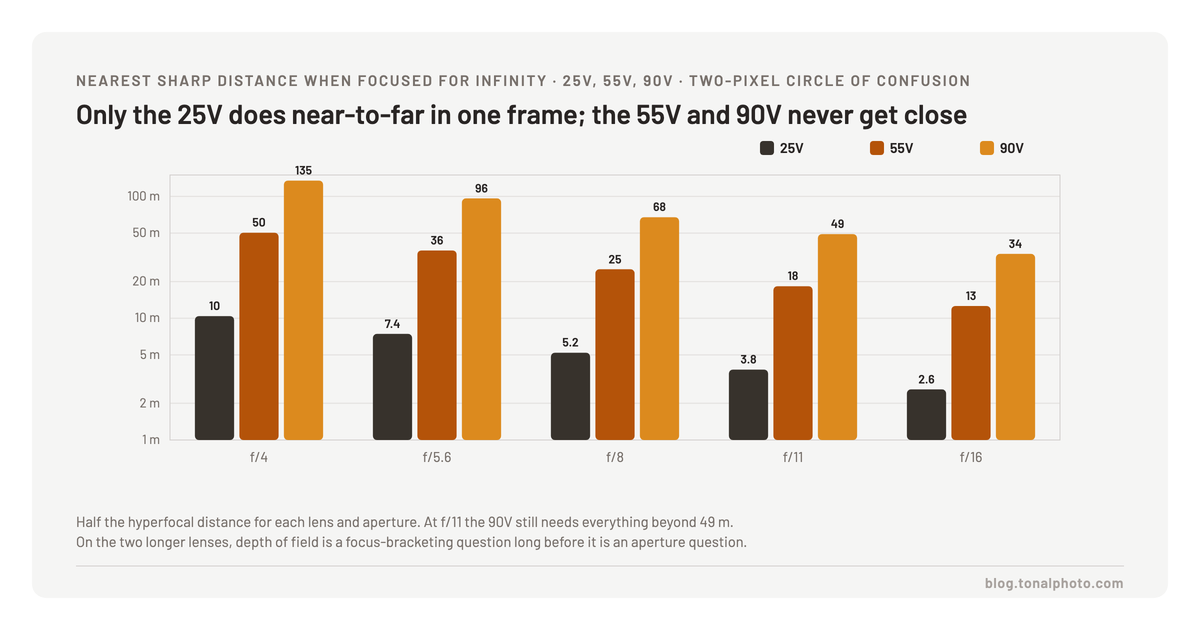
How close a single frame reaches depends on how much blur you are willing to call sharp, the circle of confusion.³ I use two pixels on the X2D II, 7.5 µm. Focus the 25V at the hyperfocal distance and the nearest sharp thing is 7.4 m (24 ft) away at f/5.6, 5.2 m (17 ft) at f/8, 3.8 m (12.5 ft) at f/11 and 2.6 m (8.5 ft) at f/16. A rock at 4 m (13 ft) makes it into the f/11 frame. A rock at 3 m (10 ft) needs f/16, or a stack.
Two pixels is what holds up when I look at the file at 100% on screen. The traditional print convention makes every distance in this post about five times shorter, so on a 24-inch print the near limits are far more forgiving.
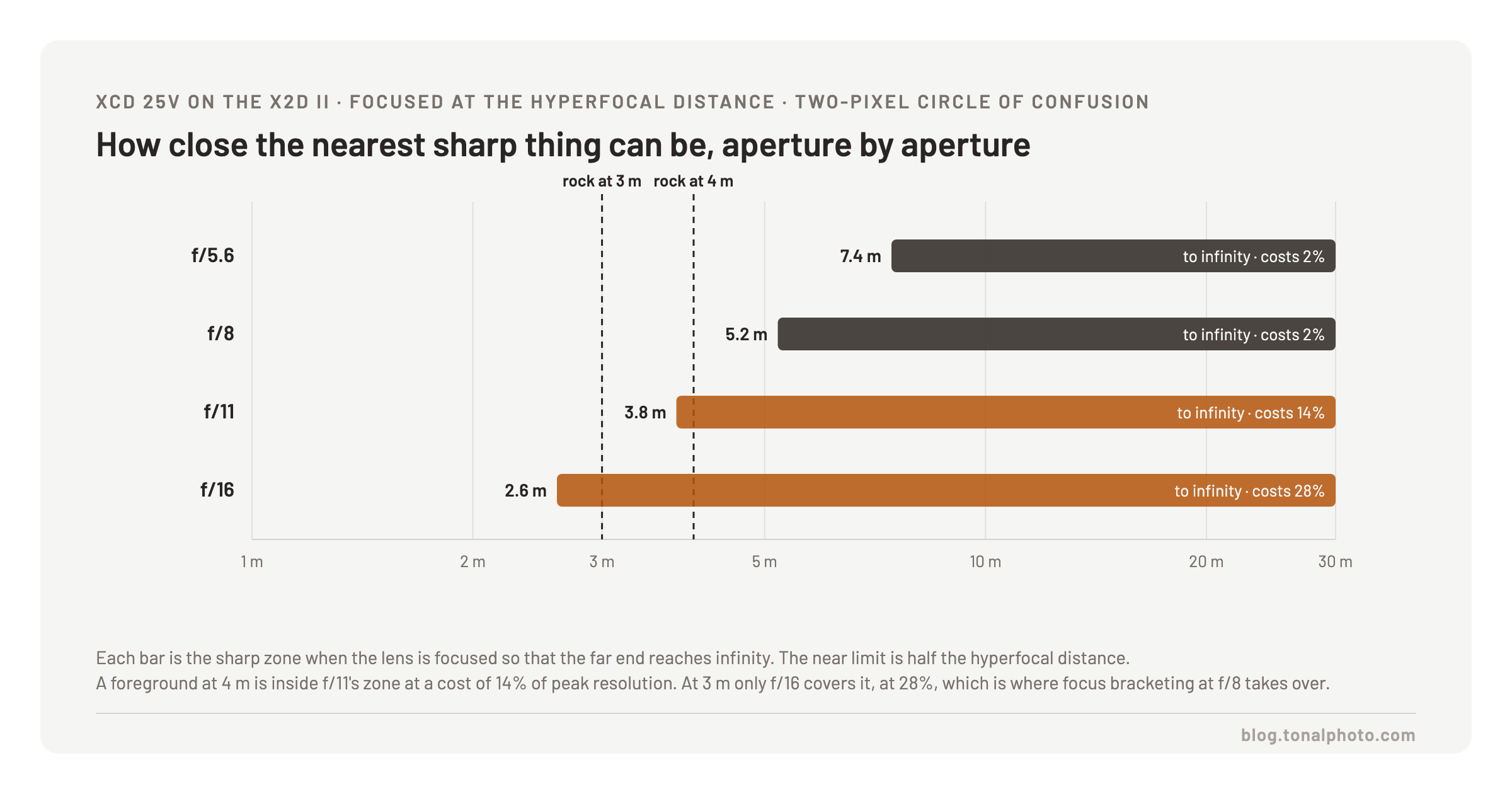
Figure 1. How close the 25V reaches in one frame with the far end at infinity, with rocks marked at 3 m (10 ft) and 4 m (13 ft).
What is the sharpest aperture on the X2D II when nothing is close?
f/5.6 to f/8. That's the flat top of the 25V's curve, and the measured difference between the two is 2%. I sit at f/8 out of habit, because it leaves me a stop of slack when the light changes. Wind moves me off it, and on the short lenses I'll open up when the depth allows.
Researching and writing the blog and page posts I produce takes up a lot of my time and costs me money for software subscriptions, tooling, and other incidentals related to running a business.
Please consider a paid membership to help me keep the lights on and pay the bills - it is only a fraction of the cost of an X2D II and a lens. Click on the button to go to the membership page to see the options available.
Forest in wind: shutter and ISO first
The shutter goes first in a forest, and the aperture last. I never go slower than 1/160 s in a breeze, 1/250 s in a stiffer wind, and flowers moving in the wind get at least 1/500 s.
ISO 50 when there is enough light, ISO 200 and up when there isn't. In a forest there usually isn't, so ISO is whatever it takes after the shutter is set, and that is ISO 1600 and up. I've almost never shot a forest below 1600, because there is never enough light. The exception is snow, when everything in the frame is white and reflecting.
I don't obsess over ISO 50. A month ago I'd have said I'll shoot whatever ISO gets me the shot, up to 25,600, and clean it up afterwards. Today I stop at ISO 6400, two stops below that, and I still get nearly every shot I was getting at 25,600. I measured why for the ISO invariance post: read noise on the X2D II drops about 2.8 times at ISO 200 and stays close to flat above it. Noise reduction is still HNNR, from ISO 1600 up. I've not yet seen anything else produce better results, and HNNR hands me a denoised 3FR, which I can take straight into Lightroom Classic, or lift two stops or so in Phocus first and export a 16-bit TIFF.
If the scene also wants depth, I'll go to f/16 on purpose. It costs 28% of the resolution, and a smeared leaf loses the frame. A focus bracket is no help here, because the leaves won't hold still between frames.
Coast and moving water: f/8 and an ND filter
Water gets f/8 and a filter, never f/22. From 1/60 s at f/8, stopping down to f/22 only gets to 1/8 s and costs 43% of the resolution. A 3-stop ND gets to the same 1/8 s at f/8, a 6-stop to 1 s and a 10-stop to 16 s.
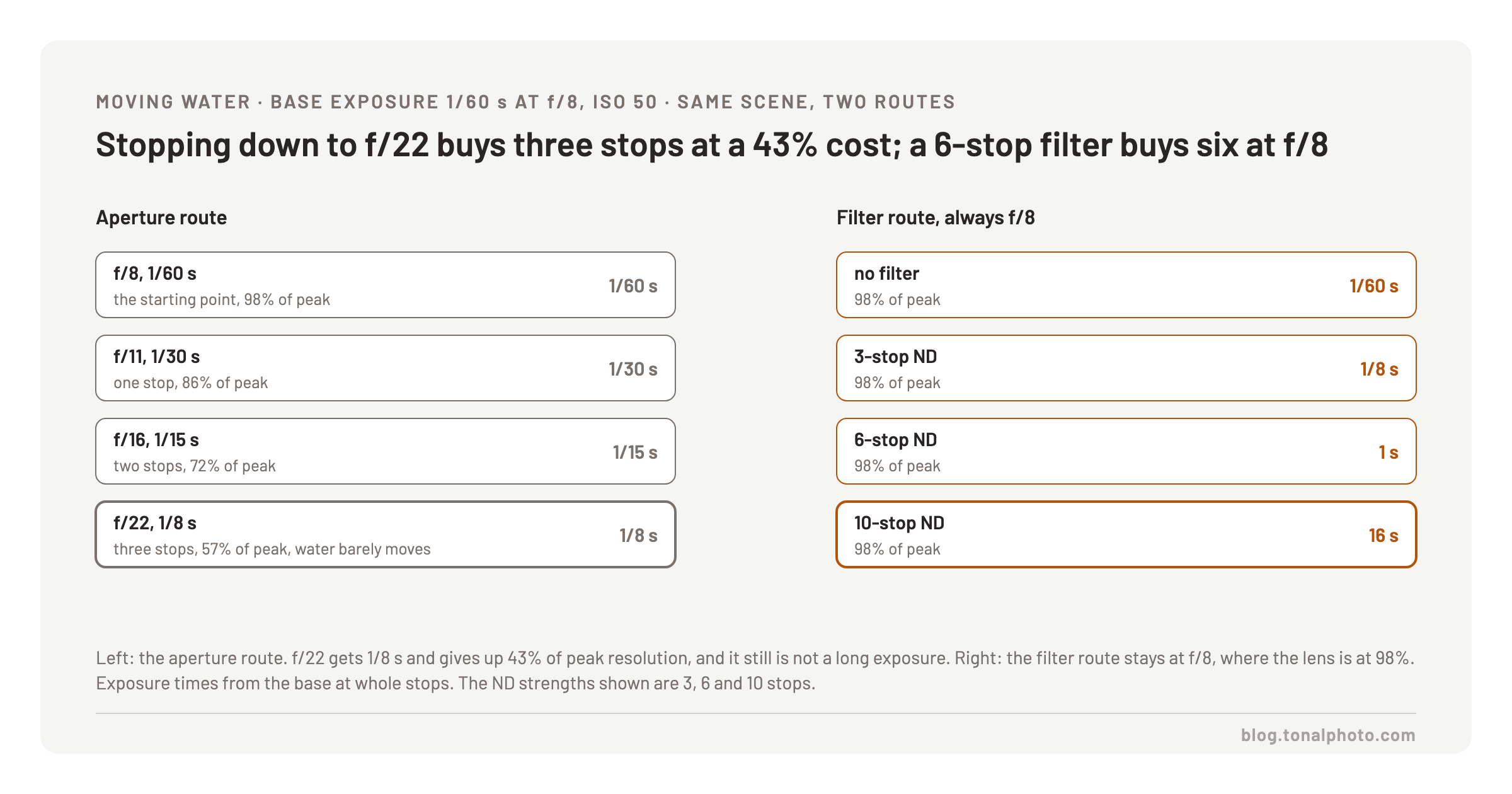
Figure 2. Two routes from 1/60 s at f/8. The aperture route ends at f/22 with three stops of time. The filters gain up to ten and leave the lens at f/8.
I carry a Maven filter set: a 3-stop, 6-stop and 10-stop ND, and a linear polarizer. The polarizer lives on the camera most of the time, and comes off in flat light or low light. The NDs come out when there's too much light even at ISO 50 and I want a long exposure. Stacking the polarizer on an ND costs about another stop and a half, and that comes out of the shutter, not the aperture. Filters add a color cast, which the white balance eyedropper in Phocus fixes.
Close detail: f/8 and a focus bracket
Moss, a tide pool, lichen on a boulder. At 1 m (3.3 ft) on the 25V a single frame at f/8 holds about 19 cm (7.5 in) of depth. f/16 stretches that to about 40 cm (16 in), at the same 28% cost as the forest trade.
So I bracket. The X2D II works out the focus step itself from the focus distance, focal length, aperture and pixel pitch, and stops when it reaches infinity or the frame count.⁴ I set f/8, a medium step and more frames than I think I need. Phocus doesn't stack the result; Helicon Focus or Photoshop does.
Have you seen the guide? I've published Essential Phocus 4.x for Mac - 85 topics across 8 sections and 250 pages covering everything from HNCS color science to HDR workflows. It's the reference manual Hasselblad hasn't updated since 3.8. It's $49, and updates are included.
The 90V and 55V on the X2D II
The 90V is in my opinion one of the finest lenses Hasselblad makes, and 90 mm is one of my favorite focal lengths to work with. Compared to the 25V, though, f/8 of course buys a lot less depth of field. At f/8, focused at the hyperfocal distance, the nearest sharp thing is 68 m (221 ft) away on the 90V and 25 m (83 ft) on the 55V, against 5.2 m (17 ft) on the 25V. On those two lenses a foreground is a bracketing problem, or it isn't in the frame. Jim Kasson's Siemens star measurements of the 90V on the X2D show diffraction "seriously affecting sharpness at f/11".⁵
Here are the hyperfocal distances for all three lenses at two pixels. The near limit is half of each.
| Lens | f/4 | f/5.6 | f/8 | f/11 | f/16 |
|---|---|---|---|---|---|
| 25V | 20.8 m / 68 ft | 14.9 m / 49 ft | 10.4 m / 34 ft | 7.6 m / 25 ft | 5.2 m / 17 ft |
| 55V | 100.8 m / 331 ft | 72.0 m / 236 ft | 50.4 m / 165 ft | 36.7 m / 120 ft | 25.2 m / 83 ft |
| 90V | 270.0 m / 886 ft | 192.9 m / 633 ft | 135.0 m / 443 ft | 98.2 m / 322 ft | 67.5 m / 221 ft |
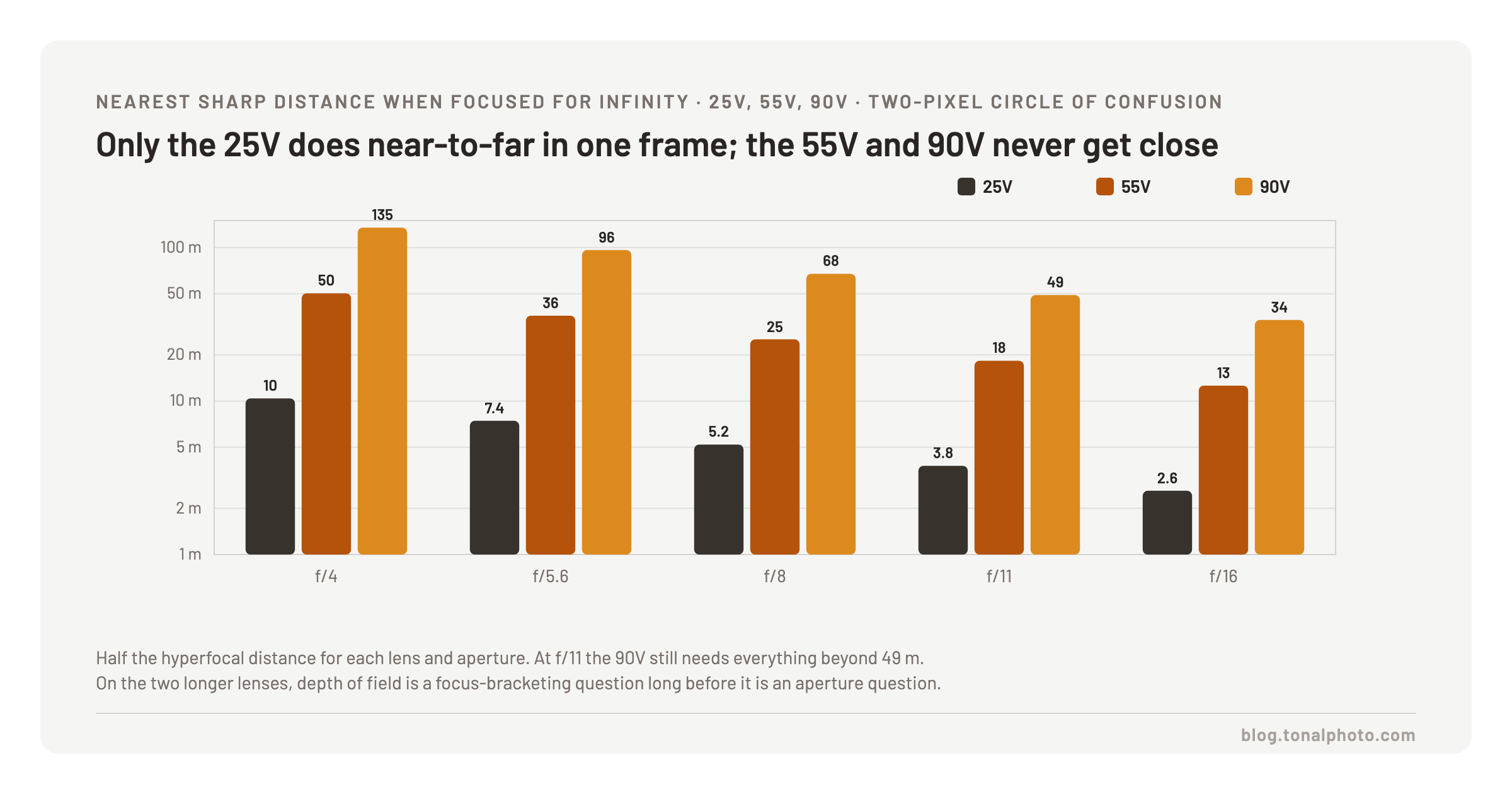
Figure 3. The near limit for each lens and aperture, at two pixels. Only the 25V does near-to-far in a single frame.
Handheld at blue hour on the X2D II
Handheld, the aperture moves first. The 25V at f/4 is at 93% of its peak, and wide open at f/2.5 it's at 74%, so I open to f/4 and then all the way if I need to. ISO moves after that, straight from 50 to 200 and then as high as it has to go. I skip ISO 100 entirely: it has ISO 50's read noise with less highlight headroom, and the ETTR post has the details.
The slowest I'll hand-hold is ~2 s, on the 25V, the 55V and the 90V. That's unbraced, with the stabilizer on and Phocus Mobile connected within the previous four hours so that Earth Rotation Compensation has a location fix.
What I never set
f/22 and f/32. From f/27 the measured resolution sits on the diffraction-only line, which means any lens would give the same result there, so I bracket when I need depth and use a filter when I need time. The Airy disk page has the physics.
Auto white balance. Every frame is Daylight, 5000 K. HNCS does its work at render time, and a fixed white balance keeps a day's frames consistent in Phocus.
HNNR below ISO 1600.
Auto ISO is the one I'll bend. Light changing under fast-moving cloud is not the reason; compensating for that by hand costs little. It's for scenes unfolding faster than I can turn dials, especially in continuous drive, where I'm getting all of 3 frames a second at best. Then auto ISO goes on, capped at ISO 6400, with exposure compensation set 2.5 stops down.
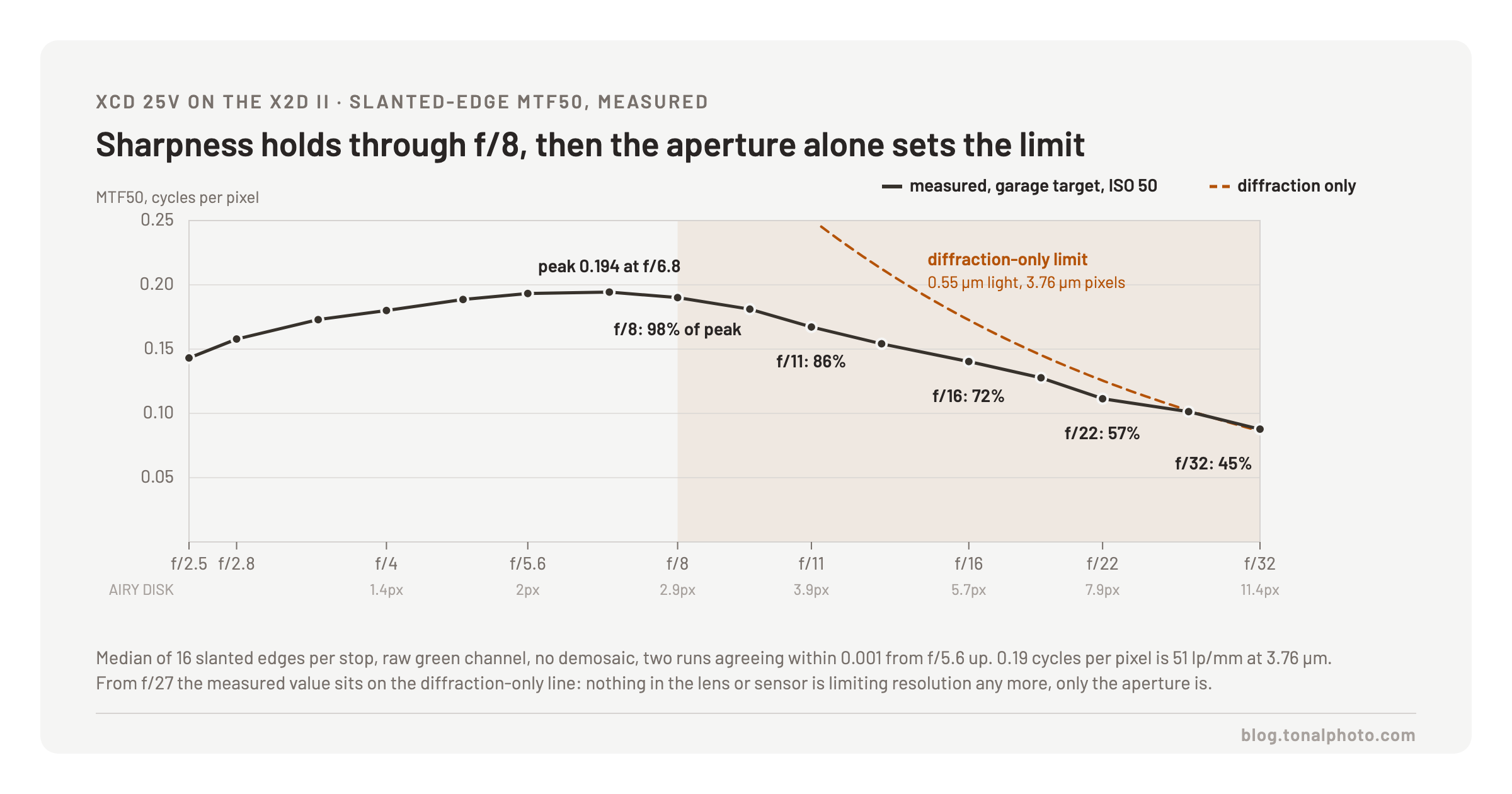
Figure 4. Measured MTF50 of the 25V from f/2.5 to f/32, with the diffraction-only limit overlaid.
References
- XCD 25V Diffraction Test: Sharpness Holds Through f/8 on the X2D II, the source of every sharpness percentage above.
- Photography Life, Hasselblad XCD 25mm f/2.5 V review, page 2 and XCD 90mm f/2.5 V review, page 2, Imatest data on the X2D 100C.
- Aperture, Equivalence, and Diffraction on Medium Format, circle-of-confusion conventions. Every distance in this post is H = f² / (N × c) with c = 7.5 µm, and the near limit is H/2 when focused at H.
- Hasselblad X2D II 100C User Manual, section 2.6 (focus bracketing) and section 5.8 (step size and circle of confusion).
- Jim Kasson, Hasselblad 90/2.5 XCD-V on X2D, Siemens star