Every lens, at every price, has a floor under how small a point of light it can draw on the sensor. Below that floor it cannot go, no matter how well it is made. The floor is set by the size of the hole the light comes through, and the spot it draws is called the Airy disk. This page is a short explanation of what that spot is, how big it gets on a Hasselblad X2D II, and why a 100 MP sensor makes it a practical problem where a 24 MP one mostly hides it.
If you came here from the XCD 25V diffraction test, the short answer is in the two figures. The longer treatment of aperture, equivalence and diffraction is on its own page.
Key finding: The Airy disk is the smallest spot a lens can focus light to. It grows with the f-number, about 1.34 µm per f-stop number in green light: 7.5 µm at f/5.6, 21.5 µm at f/16. On the X2D II's 3.76 µm pixels it spans two pixels by f/5.6, so stopping down past f/8 costs resolution.
What is the Airy disk?
Light behaves as a wave, and a wave squeezed through an opening spreads out on the far side. A lens aperture is such an opening. So when a lens focuses light from a single distant point, a star, a pinhole, the corner of a printed square, the light does not land on the sensor as a point. It lands as a small bright disk with faint rings around it. The disk is named after George Biddell Airy, the astronomer who worked out its shape in 1835¹.
Its size depends on the colour of the light and on the f-number of the lens, and on nothing else. Longer wavelengths spread more, so red light makes a bigger disk than blue. A higher f-number means a smaller hole relative to the focal length, so more spreading and a bigger disk. The focal length on its own does not enter into it, and neither does the price of the lens. A kit zoom and the best glass Hasselblad makes draw the same disk at f/8.
The formula is short. The diameter of the disk, out to the first dark ring, is 2.44 times the wavelength times the f-number. For green light in the middle of the visible range, 550 nanometres, that works out to 1.34 µm per f-stop number: about 5.4 µm at f/4, 10.7 µm at f/8, 21.5 µm at f/16 and 43 µm at f/32².
Have you seen the guide? I've published Essential Phocus 4.x for Mac - 85 topics across 8 sections and 250 pages covering everything from HNCS color science to HDR workflows. It's the reference manual Hasselblad hasn't updated since 3.8. It's $49, and updates are included.
How big it is on the X2D II
The X2D II's pixels are 3.76 µm across³. Figure 1 draws the disk to scale on that grid at six apertures.
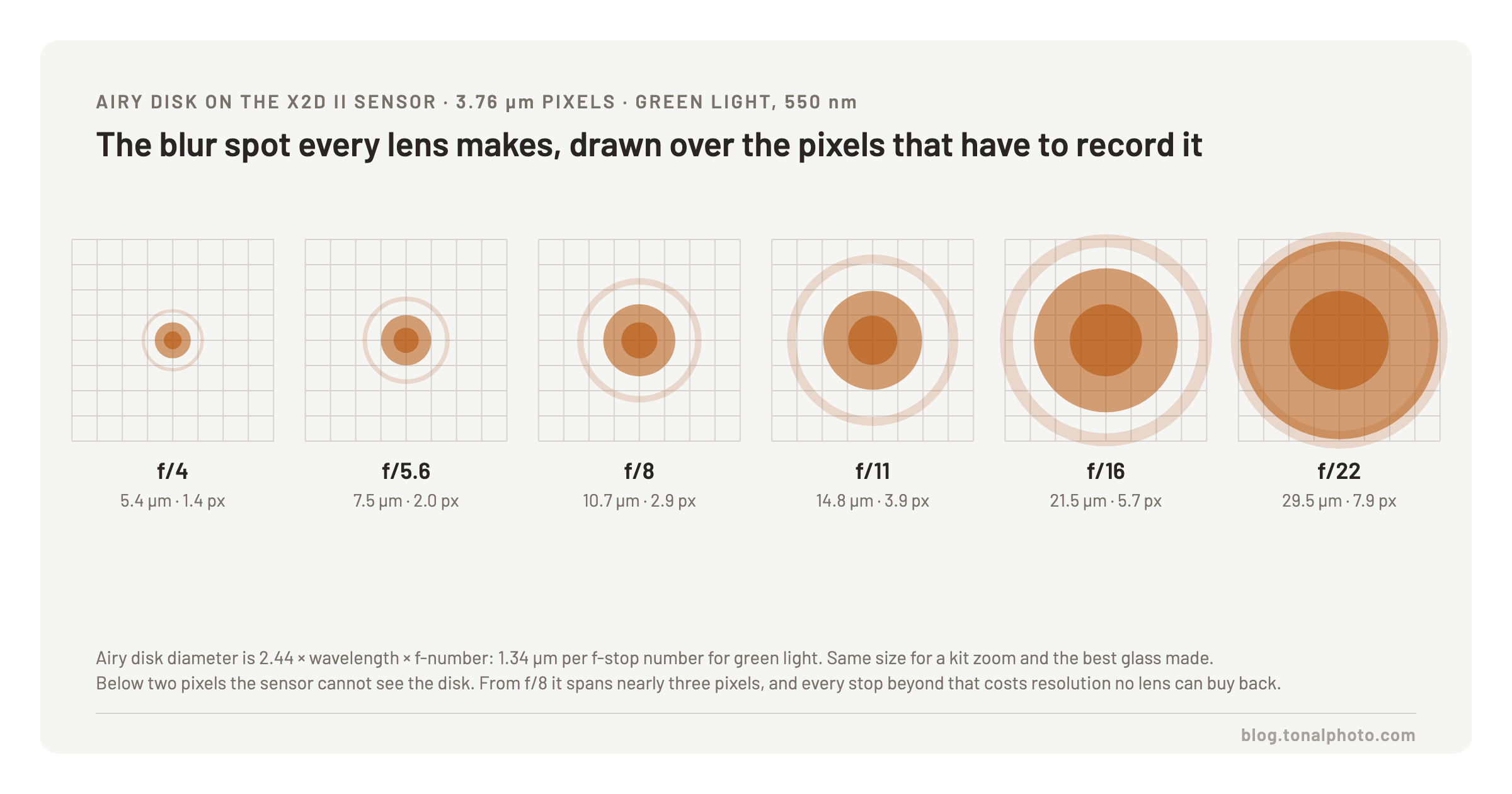
At f/4 the disk is smaller than a pixel and a half, and the sensor cannot tell it from a point. At f/5.6 it covers two pixels. At f/8 it is nearly three, at f/11 nearly four, at f/16 close to six, and at f/22 it sprawls across eight. Every one of those spots is the smallest thing the lens can draw at that aperture. Fine detail smaller than the spot is not recorded faintly; it is not recorded at all.
Why does a 100 MP sensor show diffraction that a 24 MP sensor hides?
The disk is the same size on every camera at the same f-number and the same light. What changes from camera to camera is the size of the pixels that have to record it.
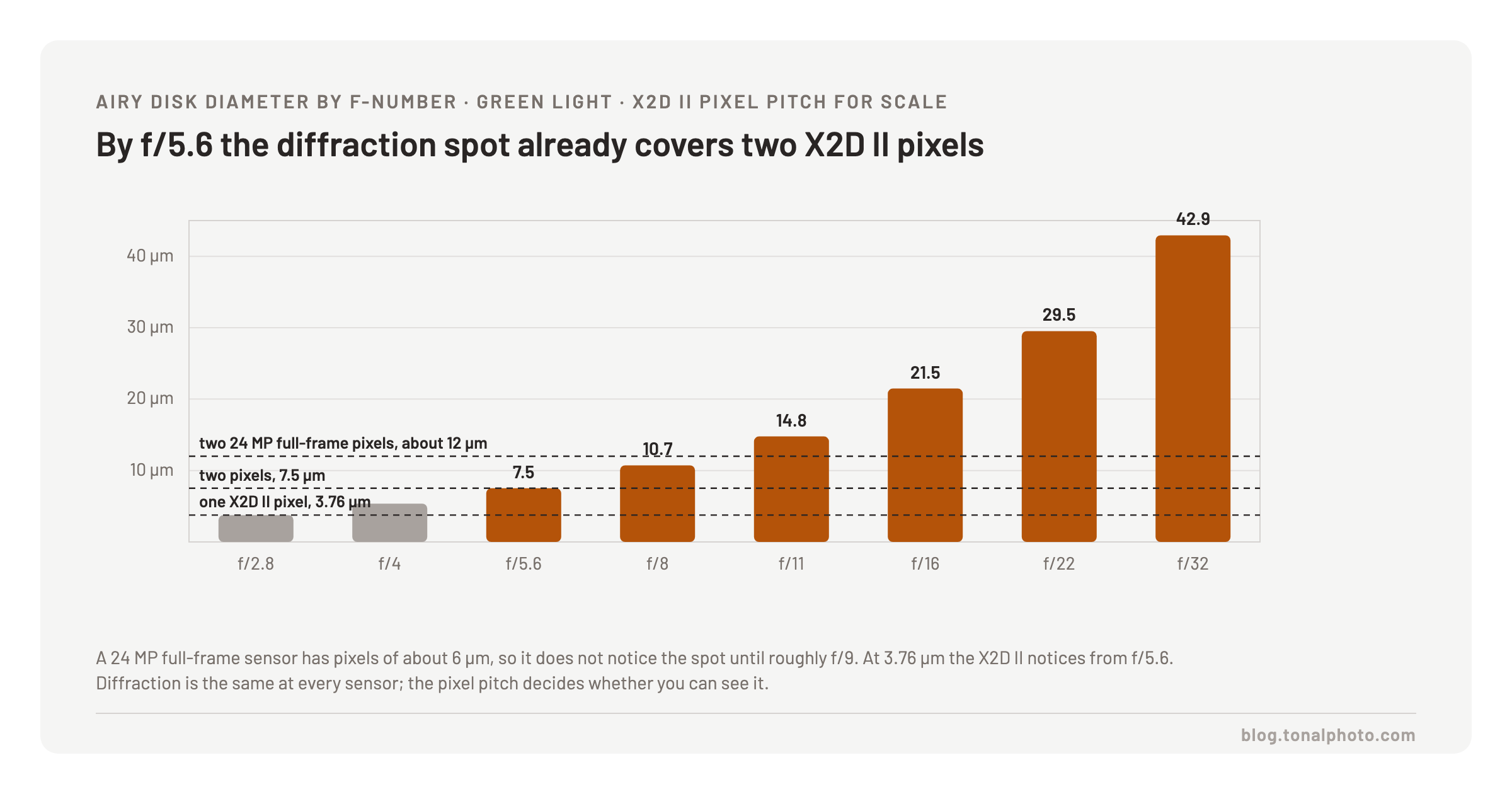
A 24 MP full-frame sensor has pixels of about 6 µm. A sensor needs roughly two pixels to record a spot as a spot rather than a point, so that camera does not see the Airy disk until it reaches about 12 µm, which happens near f/9. Photographers on those bodies learned that f/11 and f/13 were free, and they were right, for that pixel size. The X2D II's pixels are 3.76 µm, so two of them make 7.5 µm, and the disk reaches that at f/5.6. The same lens at the same aperture is now being examined by a finer ruler, and the ruler can see the blur.
That is the whole reason the "diffraction starts at f/X" rule of thumb travels so badly between cameras. The physics did not change. The pixels did.
What it means when you choose an aperture
A lens also has its own blur, from aberrations, which shrinks as you stop down. The Airy disk grows as you stop down. Wide open the aberrations dominate; somewhere in the middle the two cross; past the crossover the Airy disk is the larger of the two and stopping down further only makes things worse. On a well-corrected lens like the XCD V primes the crossover comes early.
The XCD 25V diffraction test measured this on a real target. Sharpness holds from f/5.6 to f/8, f/11 keeps 86% of peak, f/16 keeps 72%, and from f/27 the measured resolution sits exactly on the value the Airy disk alone predicts. At that point the lens has nothing left to give; the hole is the only thing setting the limit, and it would be the same hole on any lens.
None of this says never stop down. It says that on a 100 MP body the cost of doing so is visible, and it is worth knowing the size of the bill before you pay it.
Researching and writing the blog and page posts I produce takes up a lot of my time and costs me money for software subscriptions, tooling, and other incidentals related to running a business.
Please consider a paid membership to help me keep the lights on and pay the bills - it is only a fraction of the cost of an X2D II and a lens. Click on the button to go to the membership page to see the options available.
References
- Airy disk, Wikipedia, including the 1835 derivation and the 2.44 λN diameter to the first dark ring.
- Aperture, Equivalence, and Diffraction on Medium Format, the Airy disk schedule for green light and the aberration-versus-diffraction crossover.
- Hasselblad X2D II 100C datasheet, pixel size 3.76 µm.