The inevitable discussion that surfaces amongst photographers, and the question that all the folks new to photography ask: what f-stop should I be using for which scenes? When I'm shooting landscape and want the shot sharp from foreground to background I have two options: focus stack, or bump up the f-stop. But just how far can I bump it before I start seeing visible diffraction?
Someone told me, with some confidence, that the XCD 25V goes soft past f/8 on the X2D II and that f/16 is a write-off. I had written the physics page that says roughly the same thing. I could recite the Airy disk table from memory - just kidding! What I had never done though was put my own camera on a tripod and look at my own files, stop by stop, with a number attached to each one.
So of course I went and did just that. Sixteen apertures, wide open to f/32, twice, on a printed slanted-edge target, and then measured the result rather than squinting at it. This post is the evidence the physics page was missing. The derivation lives there; this is what the sensor actually recorded.
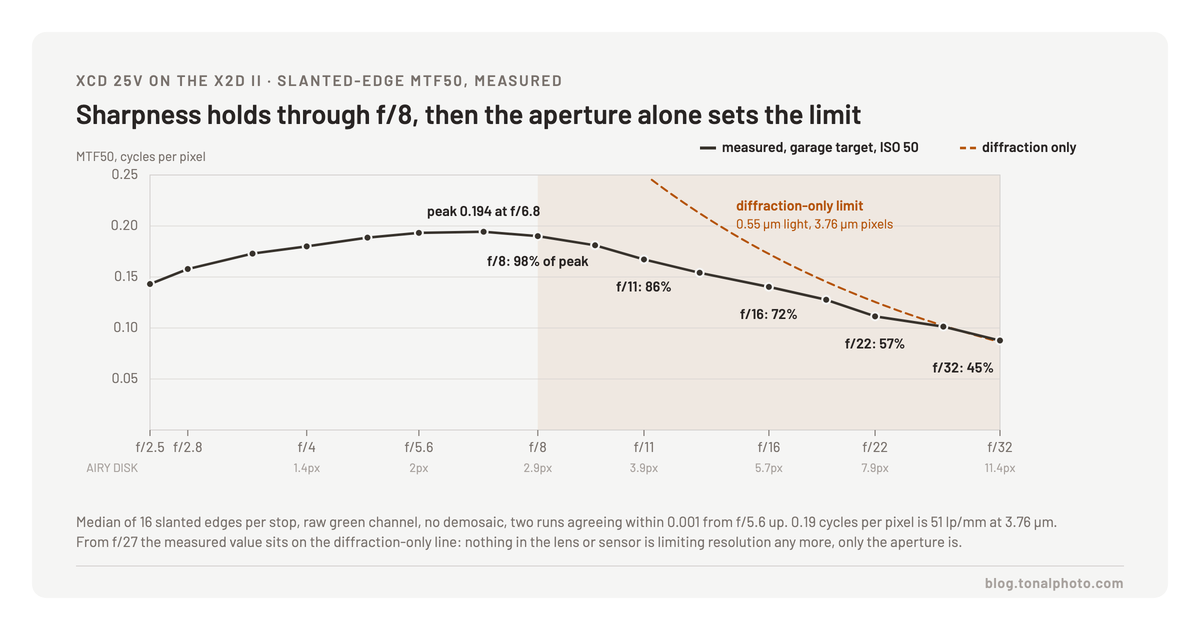
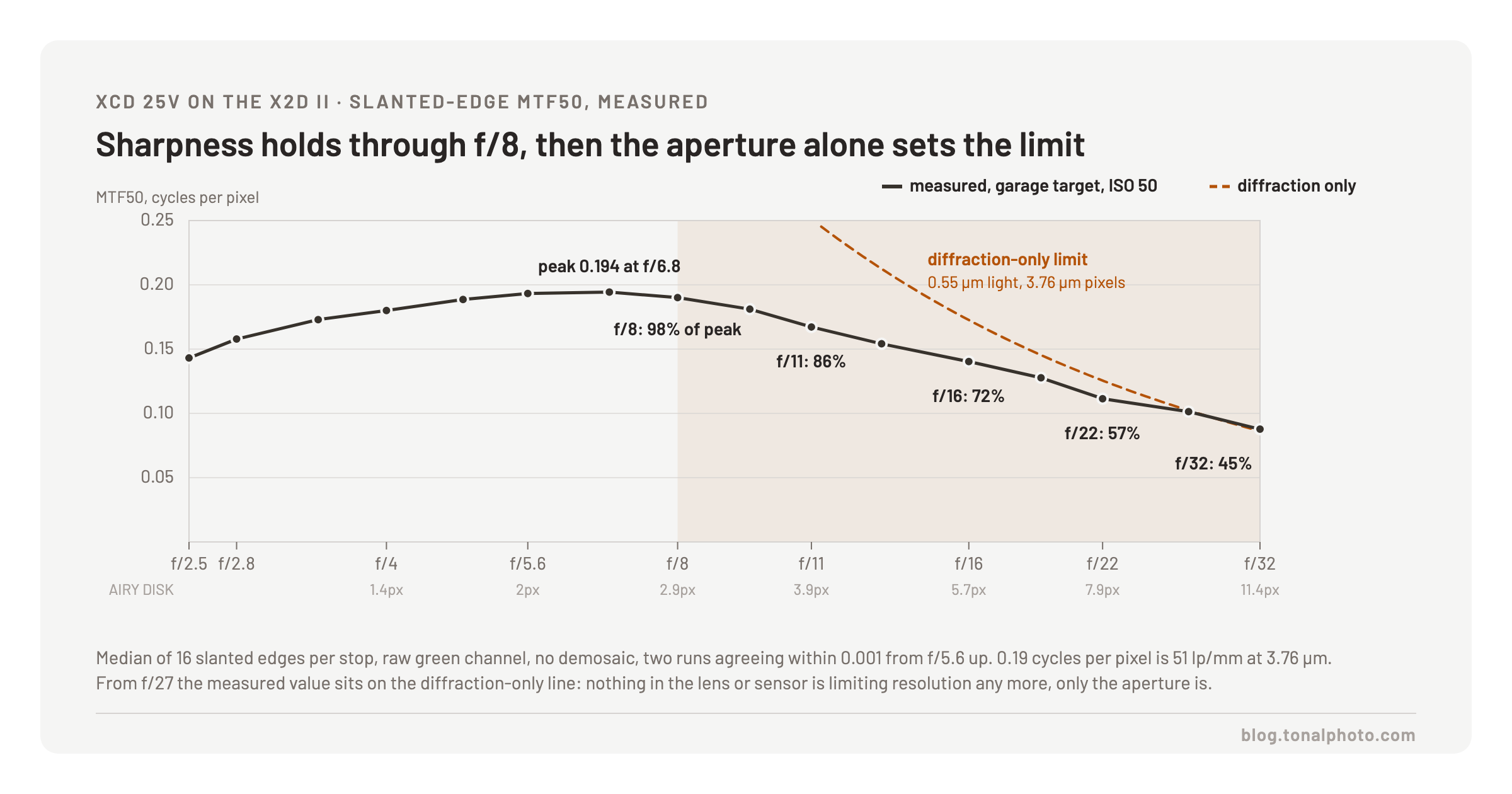
Key finding: Measured on a slanted-edge target, the XCD 25V holds peak sharpness from f/5.6 through f/8 (98% of peak). f/11 keeps 86%, f/16 keeps 72%, f/22 keeps 57%. That tail starts a stop or two earlier than on a 24 MP full-frame body, because the X2D II's 3.76 µm pixels are half the size.
The test
One lens, one target, every stop, and a number for each. The setup was chosen to remove everything except the aperture as a variable.
| Item | Setting |
|---|---|
| Body and lens | X2D II 100C, XCD 25V, firmware 1.3.16.2 |
| Target | A printed slanted-edge chart (four 90 mm squares tilted 5°) taped to a flat wall, parallel to the sensor, about a metre from the camera |
| Light | Garage, even and steady, no direct sun |
| Exposure | Aperture priority, ISO 50 fixed, shutter free, 16-bit 3FR, single-shot drive |
| Focus | Autofocus on the target, then the body switched to manual focus and the ring never touched again for the whole series |
| Stability | Heavy tripod on a concrete floor, image stabilisation off, 10 s self-timer on every frame |
| Series | Half-stop steps, f/2.5 to f/32, 16 frames per run, two runs |
| Measurement | MTF Mapper 0.7.41 on the raw green channel of each 3FR, no demosaicing, 16 edges per frame, median reported |
The measurement is MTF50: the spatial frequency at which the lens and sensor together still deliver half of the target's contrast. Higher is sharper. It is reported in cycles per pixel, so it is a statement about what the sensor recorded, independent of any raw converter. The two runs agree to within 0.001 cycles per pixel at every stop from f/5.6 up, which is the part of the curve this post is about.
It took three attempts to get a clean series, and the two failures are worth a sentence each because they are the mistakes I will make again. The first series was a backyard scene, which put depth of field back into the picture and made every corner crop meaningless. The second was indoors on a medium-weight tripod with exposures out to 23 s, and every frame of 3 s or longer showed a horizontal smear that the measurement flagged before I saw it. Moved to a solid floor, heavy tripod, self-timer, and the smear vanished.
What f/2.5 to f/32 looks like at 100%
The first sheet is the caption line printed under the target squares, cropped at native pixels from the Phocus 4.2.2 export of each frame, at default Sharpness (Amount 100, Radius 1, Threshold 0, Dark limit 1), Clarity 0, HNNR off, identical pixel coordinates in all 16 crops. The type is about 30 pixels tall, which makes it a good stand-in for the fine texture in a landscape.
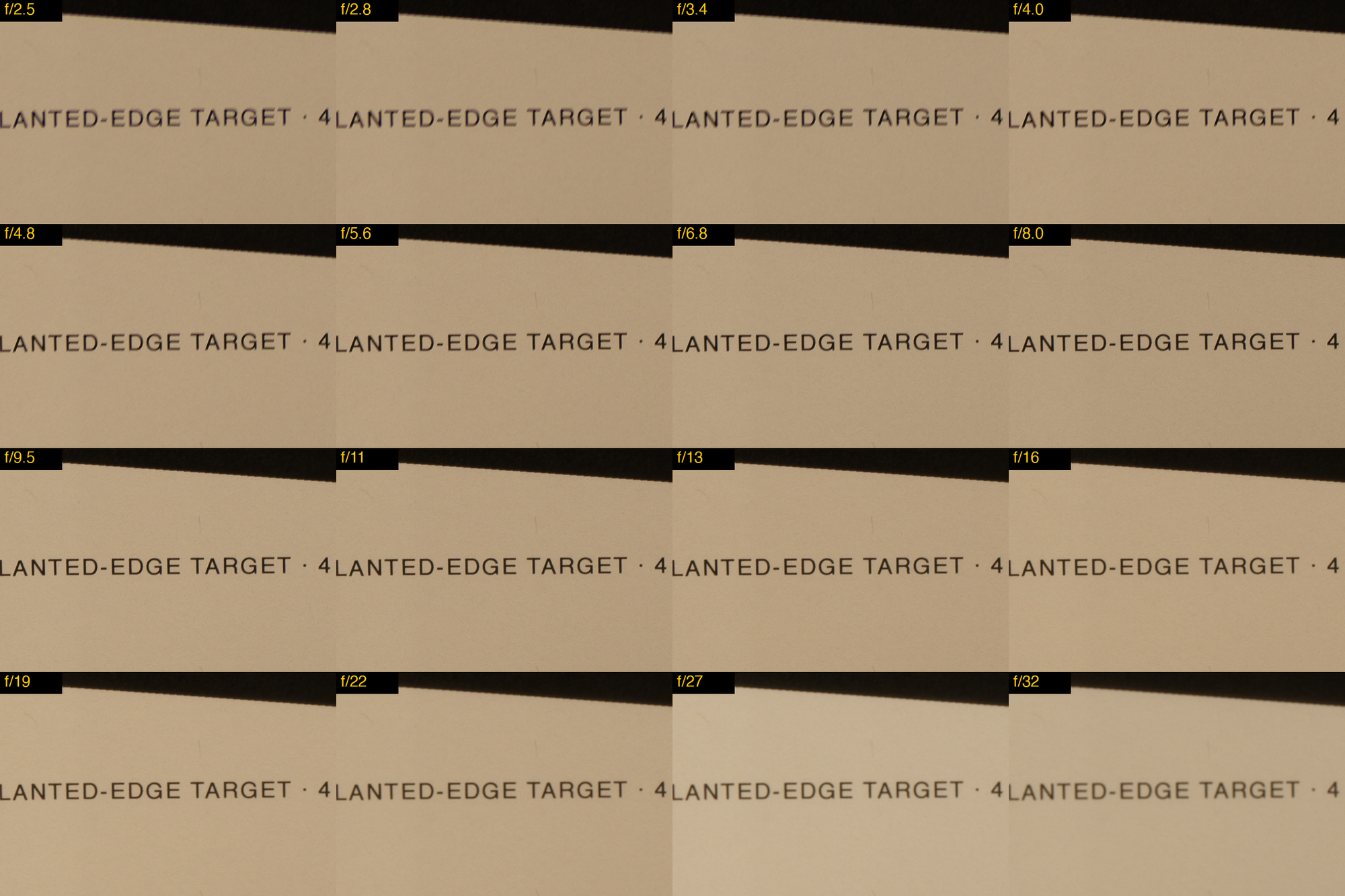
Wide open through f/4, the text is legible but the edges have a slight glow to them; the lens is not at its best yet. From f/4.8 to f/11 the letters are crisp and, frame to frame, hard to tell apart. f/13 is the first stop where I can see the edges thicken without flipping back and forth. By f/16 the softening is plain. f/22 is soft, and f/27 and f/32 are the mush the person who started this conversation was describing.
The second sheet is the top-left corner of the frame, which lands on the embossed texture of the garage door.
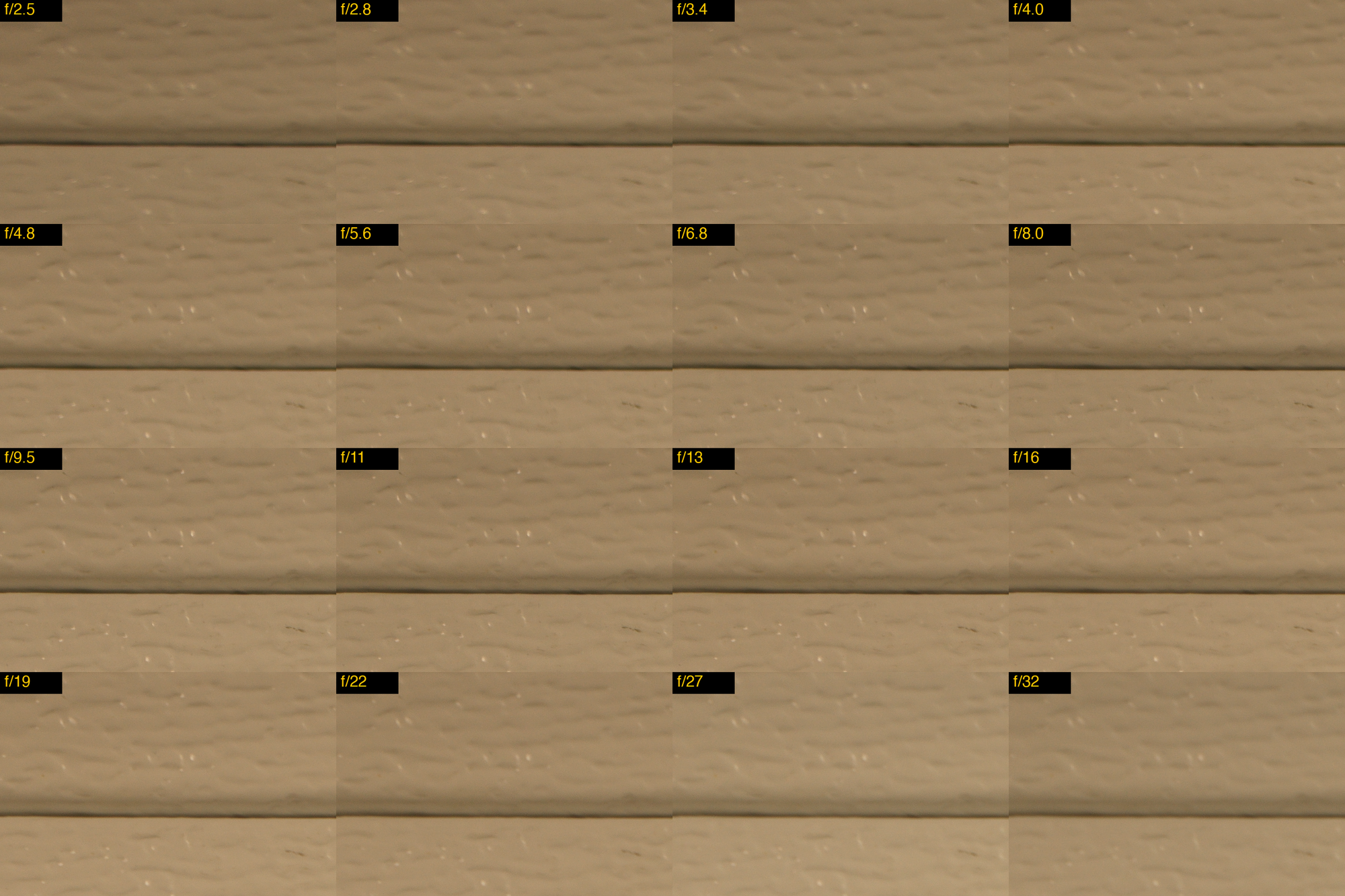
The corner tells the same story with one difference at the wide end: at f/2.5 and f/2.8 the texture is noticeably softer in the corner than in the centre, and it takes until f/5.6 to catch up. From f/5.6 to f/11 the corner holds, and from f/16 onward it follows the centre down. Diffraction does not care where in the frame you look, and the sheet shows it.
How much sharpness does f/16 cost on the X2D II?
A quarter of the lens's peak resolution, by the slanted-edge numbers, with f/11 costing 14% and f/22 costing 43%. Crops are what readers can judge for themselves, but they are also where "looks soft to me" arguments start, and the measurement settles them.
| f-number | MTF50, cycles per pixel | Percent of peak | Diffraction-only limit |
|---|---|---|---|
| 2.5 | 0.143 | 74 | 1.10 |
| 2.8 | 0.158 | 81 | 0.99 |
| 3.4 | 0.173 | 89 | 0.81 |
| 4 | 0.180 | 93 | 0.69 |
| 4.8 | 0.189 | 97 | 0.58 |
| 5.6 | 0.194 | 100 | 0.49 |
| 6.8 | 0.194 | 100 | 0.41 |
| 8 | 0.190 | 98 | 0.345 |
| 9.5 | 0.181 | 93 | 0.29 |
| 11 | 0.167 | 86 | 0.25 |
| 13 | 0.154 | 79 | 0.21 |
| 16 | 0.140 | 72 | 0.17 |
| 19 | 0.128 | 66 | 0.145 |
| 22 | 0.111 | 57 | 0.126 |
| 27 | 0.102 | 52 | 0.102 |
| 32 | 0.088 | 45 | 0.086 |
The last column is what a perfect lens on a perfect sensor would deliver from diffraction alone, for 550 nm green light and the X2D II's 3.76 µm pixels¹.
The plateau is real and it runs from f/5.6 to f/8. The difference between f/6.8 and f/8 is 0.004 cycles per pixel, four times the run-to-run noise but not something you will find in a print. f/9.5 is the first stop that costs anything I would call measurable, and f/11 is where the loss reaches a size (14%) that shows in the crops.
Past f/11 the gap between the curve and the diffraction line closes stop by stop, and by f/27 the two meet. At f/27 and f/32 the measured value and the diffraction-only prediction are within 0.002 of each other. Nothing in the lens or the sensor is limiting resolution at those stops any more; only the hole the light comes through is.
Wide open is not the peak. At f/2.5 the 25V is at 74% of its own best, which is about where it is at f/16 from the other direction. That is aberration, not diffraction, and it is the reason the crossover exists at all.\
This is also the part that catches people coming from full frame. The falloff is not a Hasselblad quirk: every lens on every camera runs into the same diffraction spot at the same f-number. What differs is the size of the pixel that has to record it. The 24 MP full-frame bodies most of us learned our f-stop habits on have 6 µm pixels and cannot see the spot until about f/9, so f/11 and f/13 were free there. At 3.76 µm the X2D II sees it from f/5.6, and a 60 MP full-frame body with the same pixel size behaves the same way. Habits carried over from the bigger pixels are what cost a quarter of the resolution at f/16. The Airy disk page has the diagrams.
Have you seen the guide? I've published Essential Phocus 4.x for Mac - 85 topics across 8 sections and 250 pages covering everything from HNCS color science to HDR workflows. It's the reference manual Hasselblad hasn't updated since 3.8. It's $49, and updates are included.
Where this disagrees with what I wrote in May
Photography Life's lab test of the same lens puts f/8 at 83% of its peak. Mine puts it at 98%. That sounds like a real disagreement, and on the page I wrote in May I had sided with the lab. The chart shows why it matters less than it sounds.
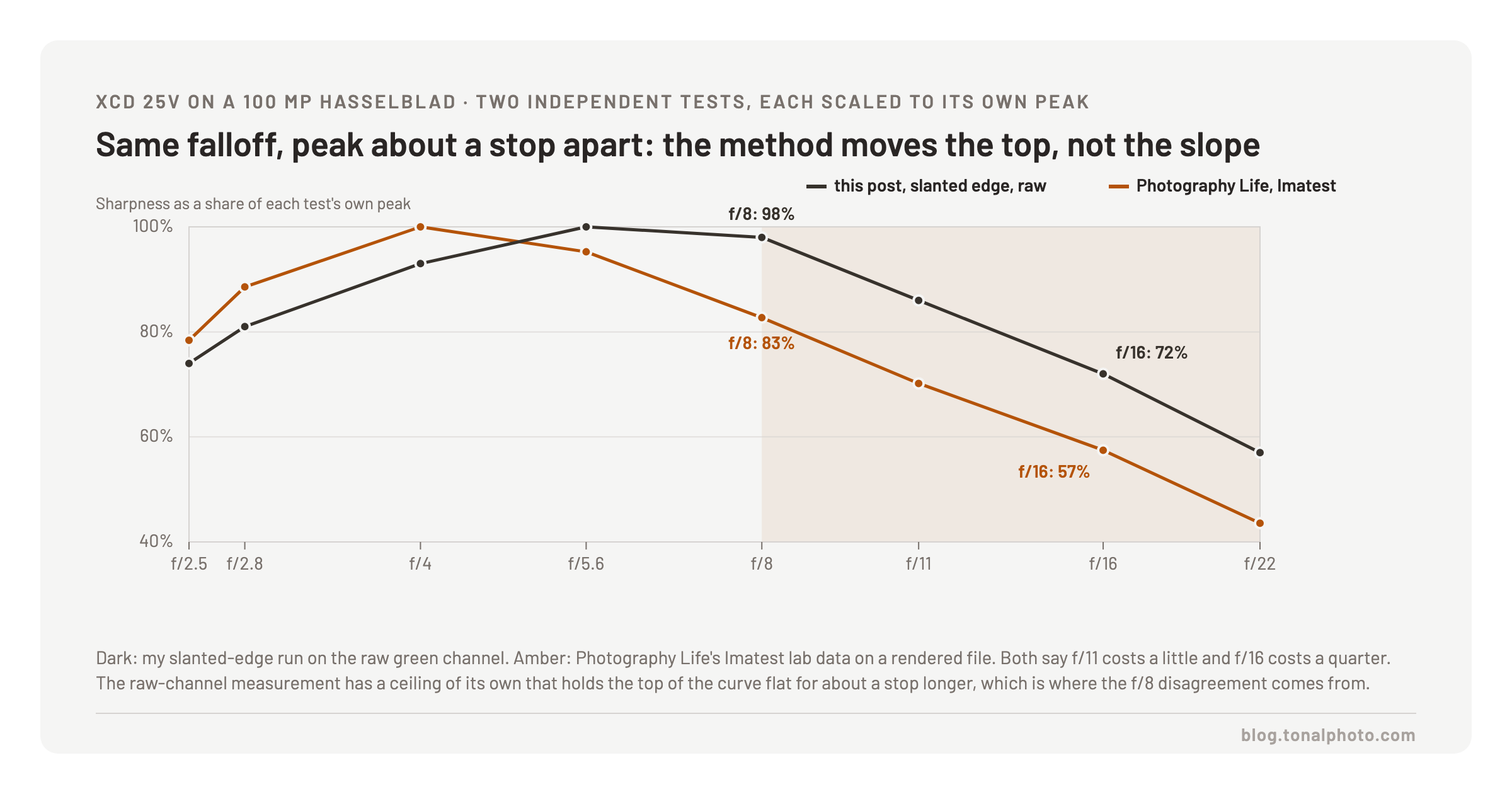
Both curves fall at the same rate once diffraction takes over. Mine peaks about a stop later, because a raw-pixel measurement has a ceiling of its own that holds the top of the curve flat, while a lab test on a rendered file does not. Past f/11 the two agree, and that is the part that decides an aperture in the field. The page's f/8 wording gets softened to match.
Does focal length change anything?
No. f/8 is f/8. The Airy disk depends on the f-number and the wavelength, and on nothing else; the entrance pupil scales with focal length exactly so that the ratio holds¹. I shot the 55V and 90V on the same target during this exercise, but with auto ISO left on by mistake, which is why their numbers are not in this post. The independent data already answers the question, though. Photography Life tested six XCD lenses on the same 100 MP sensor, and normalised to their own peaks they fall together past f/8.
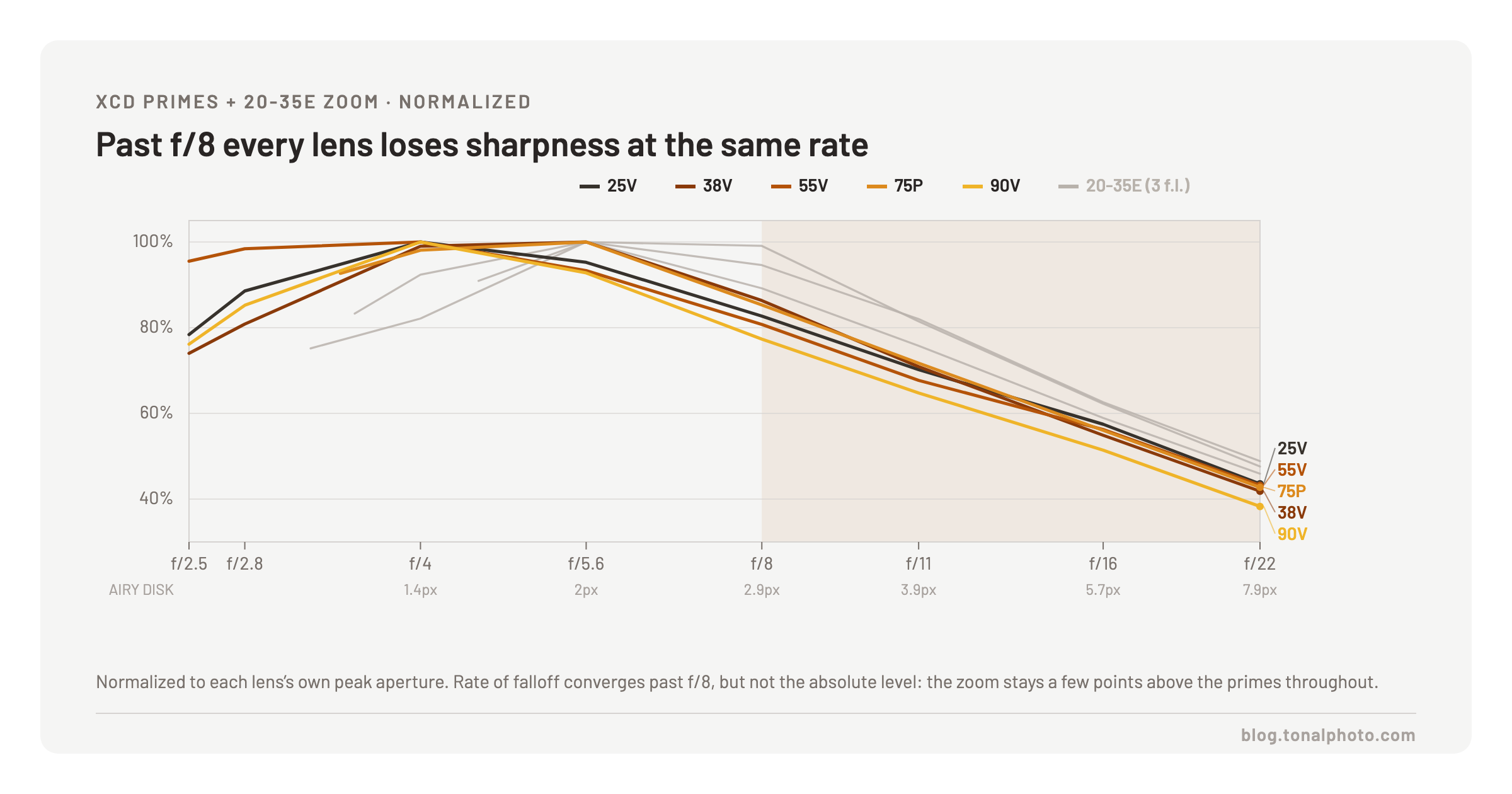
The primes sit within a few points of one another at every stop from f/8 down. The 20-35E zoom runs slightly higher, because it has more aberration to clean up as it stops down, which delays the crossover by a fraction of a stop. That is the whole story of lens-to-lens variation in diffraction: how much room each lens has below the ceiling before it converges.
Jim Kasson's Lensrentals review of the XCD 55V puts it in one sentence:
"Diffraction impairs the image sharpness at f/8"³.
On the 25V, by my measurement, it starts doing so half a stop later. Close enough to be the same lens family behaving the same way.
What I will do differently in the field
I shoot landscapes, and landscapes want depth of field, so this was never going to end with "shoot everything at f/5.6".
f/8 is free. I had been treating it as a small compromise on the 25V and it is not; the plateau runs through it. f/9.5 and f/11 are the working range when the scene needs the depth, and the 14% at f/11 is a price I will probably pay without a second thought for a foreground that is actually sharp. f/13 and f/16 are for when nothing else will do, and I now know what they cost: a quarter of the lens's resolution at f/16.
Beyond f/16 the answer is not aperture. From f/19 the curve is within a whisker of the diffraction line, and at f/27 it is on it, so the only thing more stopping down buys is more depth of field at a resolution any lens would deliver. The XCD lens guide has the list of what the V primes do well; none of it happens at f/22. For a scene that genuinely needs near-to-far sharpness beyond what f/11 covers, focus bracketing at f/8 and stacking afterwards keeps every frame on the plateau.
The next shoot is the one this started with, a foreground rock and a distant ridge on the 25V. It will be at f/11 max, and I will stop second-guessing it.
Researching and writing the blog and page posts I produce takes up a lot of my time and costs me money for software subscriptions, tooling, and other incidentals related to running a business.
Please consider a paid membership to help me keep the lights on and pay the bills - it is only a fraction of the cost of an X2D II and a lens. Click on the button to go to the membership page to see the options available.
References
- Hasselblad X2D II 100C datasheet, pixel size 3.76 µm, 11656 × 8742 pixels. Airy disk diameter and the diffraction-only MTF50 limit derived on Aperture, Equivalence, and Diffraction on Medium Format.
- Photography Life, Hasselblad XCD 25mm f/2.5 V review, page 2 (Imatest data)
- Jim Kasson, Technical Review of the Hasselblad XCD 55V Lens, Lensrentals
- MTF Mapper by Frans van den Bergh, version 0.7.41, slanted-edge MTF50 measurement