
If you're new to the Hasselblad X System, the lens lineup can feel overwhelming. Eighteen lenses across four generations, three naming conventions that nobody explains, overlapping focal lengths, and a mix of primes and zooms with different shutter speeds, filter sizes, and feature sets. Forum threads about which lens to buy routinely hit 40+ comments without reaching consensus.
This guide is an attempt to lay out the full picture in one place: what every XCD lens is, how the naming works, which lenses overlap, and what the community has learned about living with them. I'll cover the specs (verified against Hasselblad's own datasheets), the practical considerations that specs don't capture, and the gaps in the lineup that Hasselblad hasn't filled yet.
A note on support: This post represents my personal exploration and testing, not official technical support or guidance from Hasselblad. If you need assistance with your Hasselblad equipment, please contact Hasselblad directly: customersupport@hasselblad.com for global support, support.us@hasselblad.com for the Americas, or visit hasselblad.com/support for regional options.
Medium Format and Full-Frame Equivalents
The X System uses a 44x33mm sensor, which is larger than 35mm full frame (36x24mm) but not by as much as people sometimes assume. The crop factor is approximately 0.79x relative to full frame.¹
To convert XCD focal lengths to full-frame equivalents, multiply by 0.79:
- 25mm XCD = ~20mm full-frame
- 55mm XCD = ~43mm full-frame
- 90mm XCD = ~71mm full-frame
Depth of field also shifts. At the same framing and aperture, the larger sensor produces shallower depth of field than full frame. An XCD lens at f/2.5 gives roughly the depth of field you'd get at f/2 on a full-frame body.
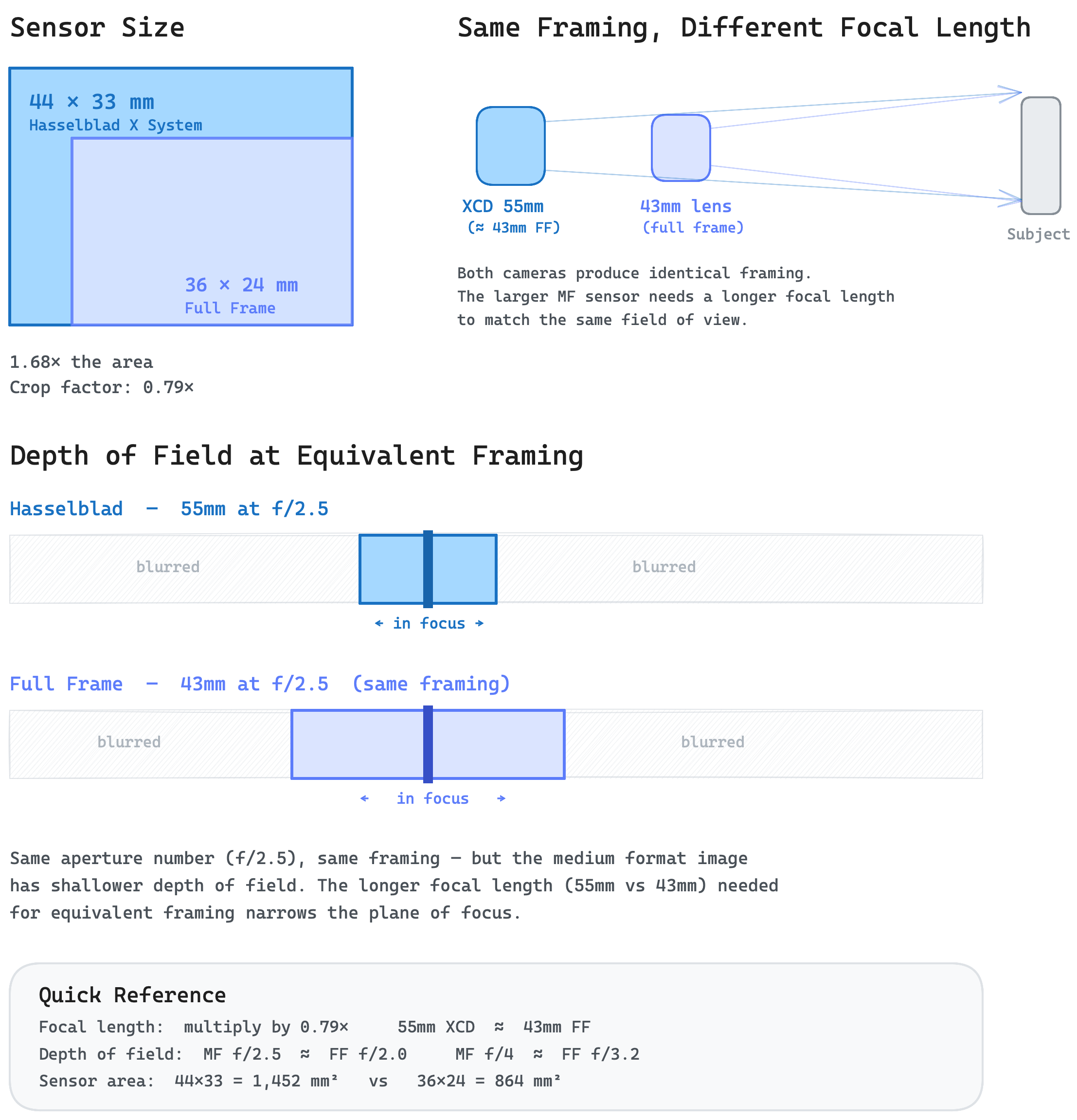
This matters when comparing lens specs across systems. An XCD 55mm f/2.5 isn't "slower" than a full-frame 50mm f/1.4 in the way the numbers suggest. The framing is similar (~43mm equivalent), and the depth of field separation is comparable to around f/2 on full frame. For every common f-stop, see the equivalent f-stop and depth of field chart.
What V, P, and E Mean
Hasselblad reorganized the XCD lineup starting in 2022 into three tiers. The naming reflects design philosophy, not quality ranking. All XCD lenses resolve far more than the 100-megapixel sensor requires.
V = Versatile
The V lenses are the core of the modern lineup. Four primes, all at f/2.5, designed to balance performance and portability.¹
What sets them apart from the original (no-suffix) lenses:
- Dedicated control ring on the barrel (programmable for aperture, shutter speed, ISO, or EV)
- Push/pull AF-MF switching on the focus ring, with visible distance and depth-of-field scales
- Updated linear stepping motor for faster, quieter autofocus
- Smaller, quieter leaf shutter
- Consistent 72mm filter thread across all four V primes
Two of the V primes, the 25V and 90V, add a feature the 38V and 55V lack: a physical switch that de-clicks the control ring for smooth, stepless aperture changes. All four share the same customisable control ring; only these two can de-click it. Often described as useful for video, though current X-bodies don't shoot video.
Hasselblad's own definition of the V in these lens names is "Versatile." Anyone coming from film photography and remembering the classic V System bodies (500C/M, 503CW, etc.) will hear the echo too.
See Aperture, Equivalence, and Diffraction on Medium Format for the per-lens sweet spot and diffraction threshold on each XCD V prime.
Researching and writing the blog and page posts I produce takes up a lot of my time and costs me money for software subscriptions, tooling, and other incidentals related to running a business.
Please consider a paid membership to help me keep the lights on and pay the bills - it is only a fraction of the cost of an X2D II and a lens. Click on the button to go to the membership page to see the options available.
P = Portable
The P lenses prioritize size and weight above all else. They're the most affordable entry into XCD glass.¹
Trade-offs compared to V lenses:
- Slower maximum apertures (f/3.4 to f/4)
- No control ring
- No push/pull AF-MF mechanism
- Simpler optical designs
The XCD 4/45P at $1,099 and 320g is the most accessible XCD lens. The 4/28P at 245g is the lightest lens in the entire system. For travel, street, or situations where you need the camera to disappear into a bag, the P lenses make the X System surprisingly portable.
E = Exclusive
The E lenses are the flagship zoom optics. Complex optical designs, the widest aperture ranges, and the highest prices.¹
Currently two lenses: a wide zoom (20-35mm) and a standard zoom (35-100mm). The 35-100E includes the control ring found on V-series primes; the 20-35E does not. Neither zoom has the push/pull AF-MF mechanism. Both are substantially larger and heavier than any XCD prime to accommodate the zoom range.
Original (No Suffix)
The first-generation XCD lenses, launched from 2016 with the X1D-50C. Still sold by Hasselblad under "Other XCD Lenses." They lack the control ring, push/pull focus, and updated motor design. Nine lenses remain in the catalog, covering focal lengths the V/P/E series hasn't replaced yet (21mm, 30mm, 65mm, 80mm f/1.9, 120mm macro, 135mm).
These aren't obsolete. The XCD 1,9/80 is still the fastest XCD lens ever made. The 3,5/120 Macro is the only macro in the system. The 2,8/135 is the longest prime. If you need those focal lengths, the originals are your only option.
Have you seen the guide? I've published Essential Phocus 4.x for Mac - 85 topics across 251 pages covering everything from HNCS color science to HDR workflows. It's the reference manual Hasselblad hasn't updated since 3.8. It's $49, and updates are included.
How many Hasselblad XCD lenses are there in 2026?
Hasselblad sells 18 XCD lenses as of May 2026: 2 E-series zooms (20-35E, 35-100E), 4 V-series primes (25V, 38V, 55V, 90V), 3 P-series primes (28P, 45P, 75P), and 9 original-generation lenses. Full specs in the four tables below.
E Series (Exclusive)
| Lens | FF Equiv | Aperture | Filter | Weight | Max Mag | Max Sync | AF-C | Price |
|---|---|---|---|---|---|---|---|---|
| XCD 3,2-4,5/20-35E | 16-27mm | f/3.2-4.5 | 77mm | 805g | 1:10.6 (W) / 1:6.4 (T) | 1/2000s | No | $5,929 |
| XCD 2,8-4/35-100E | 28-79mm | f/2.8-4 | 86mm | 894g | 1:8 (W) / 1:4 (T) | 1/4000s | Yes | $4,599 |
V Series (Versatile)
| Lens | FF Equiv | Aperture | Filter | Weight | Max Mag | Max Sync | AF-C | Price |
|---|---|---|---|---|---|---|---|---|
| XCD 2,5/25V | 20mm | f/2.5 | 72mm | 592g | 1:5.8 | 1/4000s | Yes | $3,699 |
| XCD 2,5/38V | 30mm | f/2.5 | 72mm | 350g | 1:6.2 | 1/2000s | Yes | $3,699 |
| XCD 2,5/55V | 43mm | f/2.5 | 72mm | 372g | 1:6.4 | 1/2000s | Yes | $3,699 |
| XCD 2,5/90V | 71mm | f/2.5 | 72mm | 551g | 1:5.8 | 1/4000s | Yes | $4,299 |
P Series (Portable)
| Lens | FF Equiv | Aperture | Filter | Weight | Max Mag | Max Sync | AF-C | Price |
|---|---|---|---|---|---|---|---|---|
| XCD 4/28P | 22mm | f/4 | 72mm | 245g | 1:6 | 1/4000s | Yes | $1,679 |
| XCD 4/45P | 36mm | f/4 | 62mm | 320g | 1:5.2 | 1/2000s | No | $1,099 |
| XCD 3,4/75P | 59mm | f/3.4 | 72mm | 398g | 1:5.8 | 1/2000s | Yes | $2,229 |
Original Generation (No Suffix)
| Lens | FF Equiv | Aperture | Filter | Weight | Max Mag | Max Sync | AF-C | Notes |
|---|---|---|---|---|---|---|---|---|
| XCD 4/21 | 17mm | f/4 | 77mm | 600g | 1:10 | 1/2000s | No | Widest XCD prime |
| XCD 3,5/30 | 24mm | f/3.5 | 77mm | 550g | 1:9.6 | 1/2000s | No | |
| XCD 3,5/45 | 35mm | f/3.5 | 67mm | 417g | 1:6.4 | 1/2000s | No | Largely superseded by 45P |
| XCD 2,8/65 | 50mm | f/2.8 | 67mm | 727g | 1:5.4 | 1/2000s | No | |
| XCD 1,9/80 | 63mm | f/1.9 | 77mm | 1,044g | 1:6.4 | 1/2000s | No | Fastest XCD lens |
| XCD 3,2/90 | 71mm | f/3.2 | 67mm | 619g | 1:6 | 1/2000s | No | Superseded by 90V |
| XCD 3,5/120 Macro | 95mm | f/3.5 | 77mm | 970g | 1:2 | 1/2000s | No | Only macro in the lineup |
| XCD 2,8/135 | 105mm | f/2.8 | 77mm | 935g | 1:5.8 | 1/2000s | No | Longest XCD prime; works with X Converter 1,7 |
| XCD 3,5-4,5/35-75 | 28-58mm | f/3.5-4.5 | 77mm | 1,115g | 1:8.5 (W) / 1:6.5 (T) | 1/2000s | No | Superseded by 35-100E |
Which XCD lenses have the fastest flash sync speed?
Four XCD lenses sync flash at 1/4000s: the 25V, 90V, 28P, and 35-100E. All other XCD lenses sync at 1/2000s. The pattern isn't strictly generational. It's tied to the specific shutter module in each lens. This matters for flash photography, particularly daylight fill and high-speed portrait work.
- 1/4000s sync: 25V, 90V, 28P, 35-100E
- 1/2000s sync: Everything else
The pattern isn't strictly generational. The 38V and 55V are newer V-series lenses but sync at 1/2000s, while the 28P (a budget lens) gets 1/4000s. The shutter speed capability appears tied to the specific shutter module in each lens rather than the generation.
If flash sync speed is important to your work, check the spec for the specific lens you're buying. Don't assume all V-series or all E-series lenses share the same maximum.
If you're planning to actually use flash with your X2D II, the full breakdown of TTL protocol, officially supported units, Godox and Profoto compatibility, and what doesn't work lives in the Flash and TTL on the X2D II guide.
AF-C Compatibility: Not Every Lens
Continuous autofocus (AF-C) on the X2D II is only available with certain lenses. This catches people off guard, especially with the 20-35E, which is an E-series lens that doesn't support it.⁴
AF-C supported (7 lenses):
- All V primes: 25V, 38V, 55V, 90V
- Two P lenses: 28P, 75P
- One E zoom: 35-100E
Not supported (11 lenses):
- The 20-35E (despite being E-series)
- The 45P (oldest P-series lens)
- All nine original-generation lenses
The pattern maps to the focus motor. Lenses with the newer linear stepping motor and lightweight focus group got AF-C. The older focus module in the original lenses and the 45P can't track fast enough for continuous AF. The 20-35E, despite being a recent and expensive lens, uses a different internal design that doesn't support it.
Two conditions apply to all AF-C lenses: the lens firmware must be updated to the latest version, and AF-C only works in leaf shutter mode (not electronic shutter).⁴
To check whether a given lens is running current firmware without digging through Hasselblad's site, the Hasselblad Firmware Tracker lists the latest version for every XCD lens.
If you shoot anything that moves - kids, events, pets, street - check whether the lens you're considering supports AF-C before buying. On an AF-S-only lens, you're limited to single-shot focus lock.
Do Hasselblad XCD lenses have optical image stabilization (OIS)?
No XCD lens has optical image stabilization built into the lens. Stabilization on the X System lives in the camera body. The X2D II 100C uses 5-axis sensor-shift IBIS rated up to 10 stops at image centre (CIPA, measured with the 120 Macro), and the original X2D 100C uses 5-axis IBIS rated up to 7 stops. The earlier X1D and X1D II 50C bodies have no in-body stabilization at all.
The practical implication: every XCD lens, from the lightest 28P to the heaviest zoom, gets the same stabilization treatment because it comes from the body, not the optics. There's no IS-on/IS-off switch on any XCD lens, and you don't need to factor IS into the lens-buying decision. Pair any XCD lens with an X2D or X2D II body and stabilization is on by default.
How much close-up magnification do XCD lenses offer?
Maximum magnification (or reproduction ratio) expresses how large a subject appears on the sensor compared to life size. 1:2 means the subject projects at half its actual size. 1:10 means one-tenth. Lower second numbers are better for close-up work.
Only one XCD lens reaches meaningful close-up magnification: the XCD 3,5/120 Macro at 1:2. That's half life-size, not true 1:1 macro. On the 44×33mm sensor, a 1:2 ratio covers a subject roughly 88×66mm at closest focus. It's the only dedicated macro lens Hasselblad makes for the X system.
The next-best close-up option is the XCD 2,8-4/35-100E at 1:4 at the 100mm end. It's a zoom rather than a dedicated macro, but 1:4 is surprisingly useful for the sort of casual close-ups landscape and product photographers run into, and the lens is fast enough (f/4 at 100mm) to keep shutter speeds reasonable.
Everything else sits between 1:5 and 1:10. The V and P primes cluster around 1:5-1:6, which is fine for incidental close-ups but not for anything where you need real subject detail. The widest lenses (21, 30, 20-35E at wide end) reach only 1:9 to 1:10 because their short focal lengths limit close-focus magnification.
The XCD 2,8/135 reaches 1:3.4 when paired with the X Converter 1,7, which is the best non-macro magnification in the system if you already own the 135mm. More on the converter in the next section.
If close-up is part of your workflow, the 120 Macro is the only real answer. If you just want occasional close-focus without buying a dedicated lens, the 35-100E at 100mm is the most capable zoom and the 135mm + X Converter 1,7 is the best combination for reach-plus-magnification.
Does any XCD lens support a teleconverter?
The XCD 2,8/135 is the only XCD lens that accepts a teleconverter. The X Converter 1,7 (Hasselblad's naming, comma-decimal European style) mounts between the lens and camera body to extend the 135mm to an effective 226mm (178mm full-frame equivalent):
| Spec | 135mm alone | 135mm + X Converter 1,7 |
|---|---|---|
| Focal length | 135mm | 226mm |
| FF equivalent | 105mm | 178mm |
| Max aperture | f/2.8 | f/4.8 |
| Min aperture | f/32 | f/55 |
| Min focus distance | 1.0m | 1.05m |
| Max magnification | 1:5.8 | 1:3.4 |
| Weight | 935g | 1,372g |
| Length | 149mm | 195mm |
The converter is sold separately. Hasselblad also offers a bundled "XCD 135 Lens + X Converter 1,7" package (product number CP.HB.00000383.01).
No other XCD lens works with a teleconverter. If you need reach beyond what the 135mm with converter provides (about 230mm physical, 178mm full-frame equivalent), the X system simply has no further options.
Does the 9mm extension tube add useful magnification?
Hasselblad sells the X Extension Tube (9mm), a 9mm spacer that fits between the lens and the camera body. It shortens minimum focus distance and increases magnification. It's $299, weighs 89g, works across XCD lenses, and is stackable for double the effect. Autofocus and auto-exposure both still work. The X2D II's LiDAR focus assist does not function with an extension tube attached.
The math is straightforward. Adding extension behind the lens increases magnification by approximately:
Added magnification ≈ extension length ÷ focal length
So a 9mm tube on a 90mm lens adds about 0.10 of magnification on top of whatever the lens already does at its closest focus.
Here's what that works out to for the lenses you'd actually mount it on:
| Lens | Native max | With 9mm tube |
|---|---|---|
| XCD 2,5/55V | 1:6.4 | ~1:3.1 |
| XCD 3,4/75P | 1:5.8 | ~1:3.4 |
| XCD 2,5/90V | 1:5.8 | ~1:3.7 |
| XCD 3,5/120 Macro | 1:2 | ~1:1.7 |
The shorter the lens, the bigger the proportional gain (a 9mm tube on the 25V theoretically reaches around 1:1.9), but on wide and short-normal lenses the working distance collapses to nearly zero. The front element ends up almost touching the subject, which makes those numbers academic rather than useful.
The honest read: on the 120 Macro you go from half life-size to about 0.6x, and on the 90V you nearly double the magnification but still sit well short of half life-size. It's a useful addition if you already own one of these lenses and want a little more reach for occasional close-ups. It is not a substitute for a real macro lens. The 120 Macro stays the only XCD optic that crosses the threshold into meaningful close-up territory, and even with the 9mm tube it doesn't reach 1:1.
Stack two tubes (18mm total) and you double the added magnification, but you also lose more light, working distance shrinks further, and you start running into the practical limits of focusing at all.
Thanks to Fat Phoca in the blog comments for pointing out the omission.
Filter Thread Sizes: The 72mm Standard (Mostly)
One of the practical wins of the V/P lineup is filter thread standardization. Most V and P lenses use 72mm filters, meaning one set of filters covers most of your kit.
The exceptions:
- XCD 4/45P: 62mm (the smallest lens gets a smaller thread)
- XCD 3,2-4,5/20-35E: 77mm
- XCD 2,8-4/35-100E: 86mm (non-standard, expensive filters)
The original-generation lenses are less consistent: a mix of 67mm and 77mm threads across the range.
If you're building a filter kit, buying 72mm and using step-up rings for the 62mm 45P is the most economical approach. The 86mm thread on the 35-100E is worth noting before you buy - 86mm circular polarizers and ND filters aren't cheap.
The Common Comparisons
These are the matchups that come up repeatedly in forums and buying threads.
For a practitioner's take on the zoom-vs-prime tradeoff specifically, Albrecht Voss's 15-minute breakdown covers his experience shooting the 35-100E against a V-series prime kit over five years of professional work as a Hasselblad Master.
Related: my own account of owning both the 35-100E and the V primes, and switching back.
The Normal Lens Decision: 55V vs 45P vs 38V
Three lenses in the 35-43mm equivalent range, each with a different philosophy:
| XCD 2,5/55V | XCD 4/45P | XCD 2,5/38V | |
|---|---|---|---|
| FF Equiv | 43mm | 36mm | 30mm |
| Max Aperture | f/2.5 | f/4 | f/2.5 |
| Weight | 372g | 320g | 350g |
| Control Ring | Yes | No | Yes |
| Price | $3,699 | $1,099 | $3,699 |
The 55V is the closest to a traditional "normal" lens (43mm equivalent). The 45P is $2,600 cheaper and 50g lighter, but gives up 1.3 stops of aperture and the control ring. The 38V is wider (30mm equivalent, more of a moderate wide-angle) with the same f/2.5 speed.
For a first lens on a budget, the 45P is hard to argue with. For photographers who want shallow depth of field and the control ring, the choice between 55V and 38V comes down to whether you prefer a true normal or a wider perspective.
The Portrait Lens Decision: 90V vs 75P
| XCD 2,5/90V | XCD 3,4/75P | |
|---|---|---|
| FF Equiv | 71mm | 59mm |
| Max Aperture | f/2.5 | f/3.4 |
| Weight | 551g | 398g |
| Control Ring | Yes | No |
| Max Sync | 1/4000s | 1/2000s |
| Price | $4,299 | $2,229 |
The 90V is the sharper, faster, more capable lens with better flash sync. The 75P is $2,070 less, 153g lighter, and still very good. If you do flash portraiture, the 90V's 1/4000s sync advantage over the 75P's 1/2000s is significant for daylight fill.
The Zoom Decision: 35-100E vs 35-75 (Original)
The 35-100E is Hasselblad's current successor to the original 35-75 zoom, which remains on sale (often at significant discount):¹
| XCD 2,8-4/35-100E | XCD 3,5-4,5/35-75 | |
|---|---|---|
| FF Equiv | 28-79mm | 28-58mm |
| Max Aperture | f/2.8-4 | f/3.5-4.5 |
| Weight | 894g | 1,115g |
| Max Sync | 1/4000s | 1/2000s |
| Price | $4,599 | ~$3,900 |
The 35-100E is lighter, faster, has more reach, and syncs at a higher speed. The price premium is modest for the improvements. If you're buying a standard zoom today, the 35-100E is the clear choice. The old 35-75 makes sense only if you find a significant discount on the used market.
The Wide Decision: 25V vs 28P vs 20-35E
| XCD 2,5/25V | XCD 4/28P | XCD 3,2-4,5/20-35E | |
|---|---|---|---|
| FF Equiv | 20mm | 22mm | 16-27mm |
| Max Aperture | f/2.5 | f/4 | f/3.2-4.5 |
| Weight | 592g | 245g | 805g |
| Price | $3,699 | $1,679 | $5,929 |
The 28P is the lightweight, affordable wide option. The 25V is wider and faster. The 20-35E covers the full ultra-wide to moderate-wide range but costs nearly as much as both primes combined and weighs more than either. For how much resolution the 25V actually gives up as you stop it down, see the measured diffraction test.
If you need 20mm (16mm equivalent), the 20-35E is your only option. If 22mm equivalent is wide enough, the 28P at 245g and $1,679 is remarkable value.
Community-Reported Observations
The following are drawn from GetDPI and Reddit discussions. I haven't personally verified these, and they represent individual experiences that may or may not reflect systematic issues.³
XCD 2,8-4/35-100E
The 35-100E dominated GetDPI discussion for two months after release. Mixed reception:
- Optical centering variation across copies: Several experienced users reported inconsistent corner sharpness between copies, suggesting sample variation in element alignment. This is a known challenge with complex zoom designs across all manufacturers, but it's more noticeable on a 100-megapixel sensor.
- Best performance in the 35-75mm range: Multiple reports suggest the lens is sharpest in the lower portion of its zoom range, with some softening at the 100mm end.
- Zoom creep: Some users report the zoom ring creeping when pointed downward. No lock mechanism.
- 86mm filter thread: The non-standard size means expensive filters and no compatibility with the rest of the XCD lineup's 72mm standard.
- Availability: Extended backlogs at major dealers (B&H, Adorama). Tips circulated about checking Hasselblad's direct store on Monday/Tuesday evenings for restocks, and setting up Shopify alerts.
XCD 3,2-4,5/20-35E
- Green color cast in corners: Reports of a green tint in the lower right portion of the frame at sunrise/sunset lighting angles. Described by one user as "resisting correction in post." This could be related to the complex 16-element optical design and how it handles extreme-angle incident light. Phocus lens profiles may or may not correct for it depending on the severity.
Related: how Capture One's new XCD lens profiles work without focus-distance data.
XCD 2,5/38V
- Rearward focus shift in closeup work: A report of the focus plane shifting backward when stopping down during closeup photography. Focus shift is a known optical phenomenon in lenses with residual spherical aberration. On the X2D II, PDAF focuses through the taking aperture, which should compensate. This would primarily affect manual focus users who focus wide open and stop down to shoot.
What lenses is Hasselblad missing from the XCD system?
Focal lengths and capabilities the XCD system doesn't cover:
- True 1:1 macro: The 120mm Macro reaches 1:2 (half life-size). No XCD lens offers full 1:1 magnification.
- Tilt-shift: No perspective control lenses exist for the X System. Architectural and product photographers who need movements are limited to adapted lenses or stitching techniques.
- Fast wide prime wider than 25mm: The 25V at f/2.5 (20mm equivalent) is the fastest wide option. There's no f/2 or faster ultra-wide for astrophotography or low-light wide work.
- Telephoto beyond 230mm: The longest native reach is the 135mm with the X Converter 1,7, which extends it to 226mm (178mm full-frame equivalent) at f/4.8. That's the ceiling. Wildlife, sports, and distant-subject work isn't the X System's territory.
- Affordable fast normal: The 55V at $3,699 is the only fast normal-length prime. There's no equivalent of a $500 "nifty fifty."
Some of these gaps reflect the X System's positioning. It's designed for deliberate, high-quality photography - architecture, portraits, fine art, commercial work. The missing focal lengths are the ones where speed and reach matter more than resolution and color, which isn't where medium format excels.
Building a Kit: Practical Starting Points
Budget entry (2 lenses, ~$2,800): XCD 4/45P + XCD 4/28P. Covers 22-36mm equivalent for $2,778 total and under 565g combined. Add the 75P later for portraits.
Versatile core (3 lenses, ~$11,700): XCD 2,5/38V + XCD 2,5/55V + XCD 2,5/90V. Three f/2.5 primes covering 30-71mm equivalent. All share 72mm filters. One control ring behavior across the kit.
Do-everything zoom (1 lens, $4,599): XCD 2,8-4/35-100E. Covers 28-79mm equivalent in one lens. Pair with the 28P for wider coverage.
Maximum range (2 lenses, ~$10,500): XCD 3,2-4,5/20-35E + XCD 2,8-4/35-100E. Covers 16-79mm equivalent. Heavy (1,699g combined) and expensive, but two lenses handle nearly everything.
Updates
April 24, 2026: Added a maximum magnification column to all four spec tables and a dedicated section explaining close-up capability across the lineup. Added a dedicated section on the X Converter 1,7, the only teleconverter option in the XCD system. Added a note on the V-series click/de-click aperture switch, which is marketed for video but also useful for silent aperture changes during stills. Thanks to /u/bjerreman/ on r/hasselblad for suggesting all three additions.
May 6, 2026: Added a section on the X Extension Tube (9mm) covering the magnification math and the honest verdict that the gain is modest on the lenses you'd actually mount it on. Added a section answering whether XCD lenses have optical image stabilization (no, it lives in the body via IBIS). Thanks to Fat Phoca in the blog comments for the extension-tube suggestion.
May 26, 2026: Corrected the click/de-click switch attribution. Previously listed as a feature across all V-series lenses; it is specific to the XCD 2,5/90V. Thanks to Albrecht Voss for the correction.
June 5, 2026: Refined the de-click switch attribution after hands-on testing of a rented XCD 25V: the de-click switch is on the 25V and 90V, not the 90V alone. All four V primes share the customisable control ring; only these two add the switch to de-click it.
References
- Hasselblad X System Lenses - complete lineup, series descriptions, and individual lens product pages. Individual lens datasheets available as PDFs from cdn.hasselblad.com.
- Hasselblad X2D 100C Technical Specifications Datasheet (PDF) - confirms leaf shutter design and flash sync specifications.
- GetDPI Medium Format Digital forum (January-March 2026) and Reddit r/hasselblad. Thread topics include "Is the V lineup complete?" (37 comments), XCD 35-100E discussions (59 comments on size/reception), and various lens comparison threads.
- Hasselblad X2D II 100C FAQ - AF-C compatible lens list under "Focusing" section.