Export the same X2D II 3FR from Phocus 4.2.3 and from Lightroom Classic, and the colors do not match. In my July comparison, Lightroom's typical patch landed 2.4 dE2000 from Phocus, right at the edge of noticeable.¹ Put a custom camera profile fitted to Phocus renders on the Lightroom side, and on 57 fresh frames the median gap fell to 0.94.
dE2000 is a score for how different two colors look. As rules of thumb, about 1 is the edge of what you can see side by side, 2 to 3 is visible side by side on a calibrated display, and 5 is obvious.
"Hasselblad color in Lightroom" is a promise people sell. This page is the footnotes to that promise: what a profile reproduces, what it cannot, and what nobody has measured yet. The profile behind the numbers is mine, version 1e, a working tool I built and use. I am not handing it out yet, and nothing here promises a release. Treat it as a yardstick you can hold any other profile to. How I use it day to day is in Phocus Is Becoming Optional in My Hasselblad Workflow.
A note on support: This post represents my personal exploration and testing, not official technical support or guidance from Hasselblad. If you need assistance with your Hasselblad equipment, please contact Hasselblad directly: customersupport@hasselblad.com for global support, support.us@hasselblad.com for the Americas, or visit hasselblad.com/support for regional options.
Key finding: A custom X2D II profile (my version 1e, not released) lands a median 0.94 dE2000 from Phocus 4.2.3 on 57 fresh XCD 90V frames in Lightroom Classic 15.6. That holds at frame center, Standard response, as-shot Daylight white balance, lens corrections off. Lens brightening, an exposure tag and near-white tone are outside any profile.
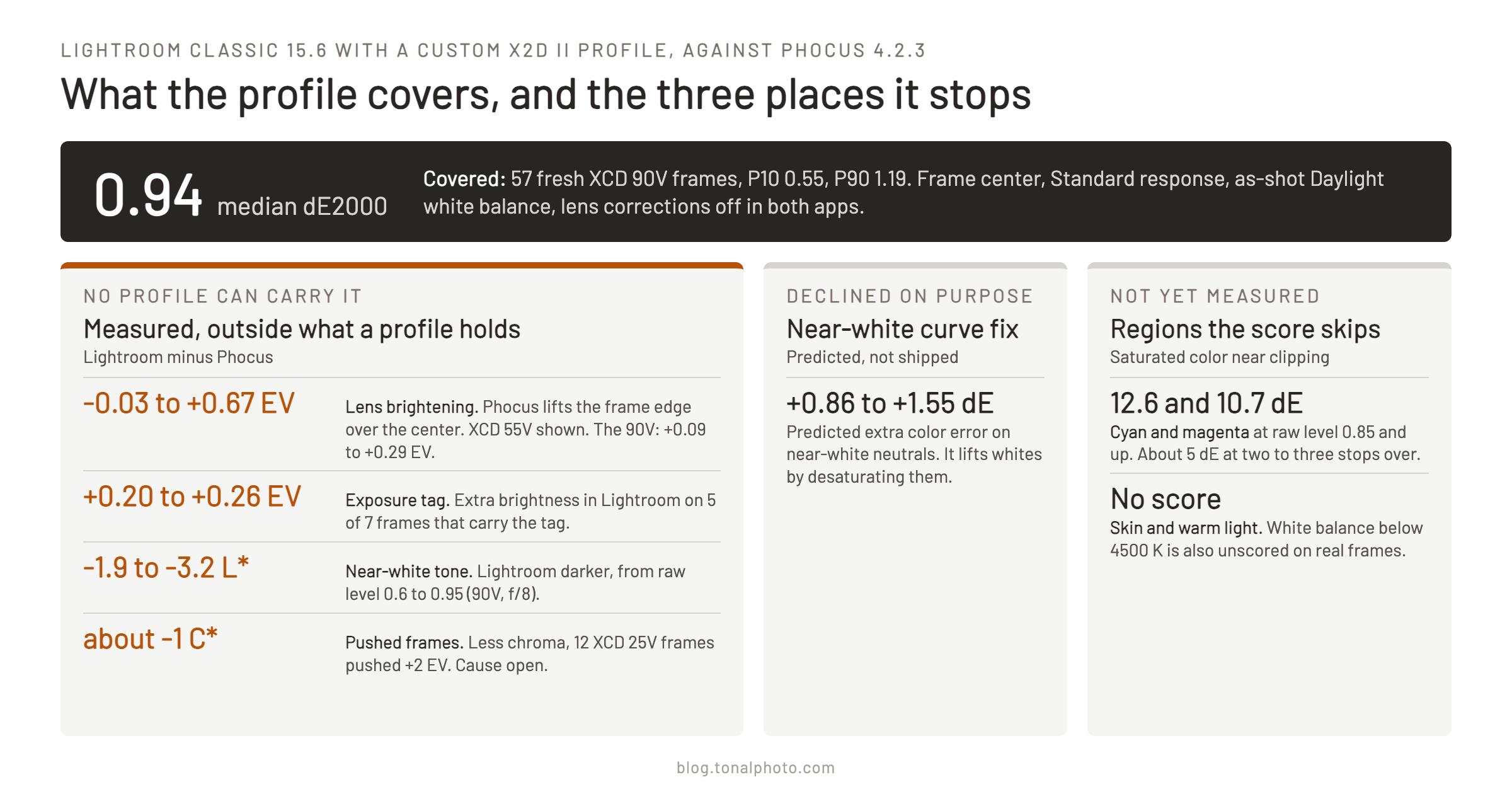
Figure 1. Every number is Lightroom Classic 15.6 against Phocus 4.2.3 on X2D II files, with lens corrections off in both apps. The 0.94 comes from 57 XCD 90V frames; the other cells come from the sets named in the text.
What does a Lightroom camera profile contain?
A camera profile (a DCP file) holds a color matrix, a table that adjusts colors by hue, saturation and brightness value, and one tone curve. That is all it holds. It has no axis for the lens, none for position in the frame, and it cannot read a file's tags. Lightroom applies it to every frame the same way.
Phocus does more than that to an X2D II file, and Lightroom does some things of its own before the profile gets a turn.
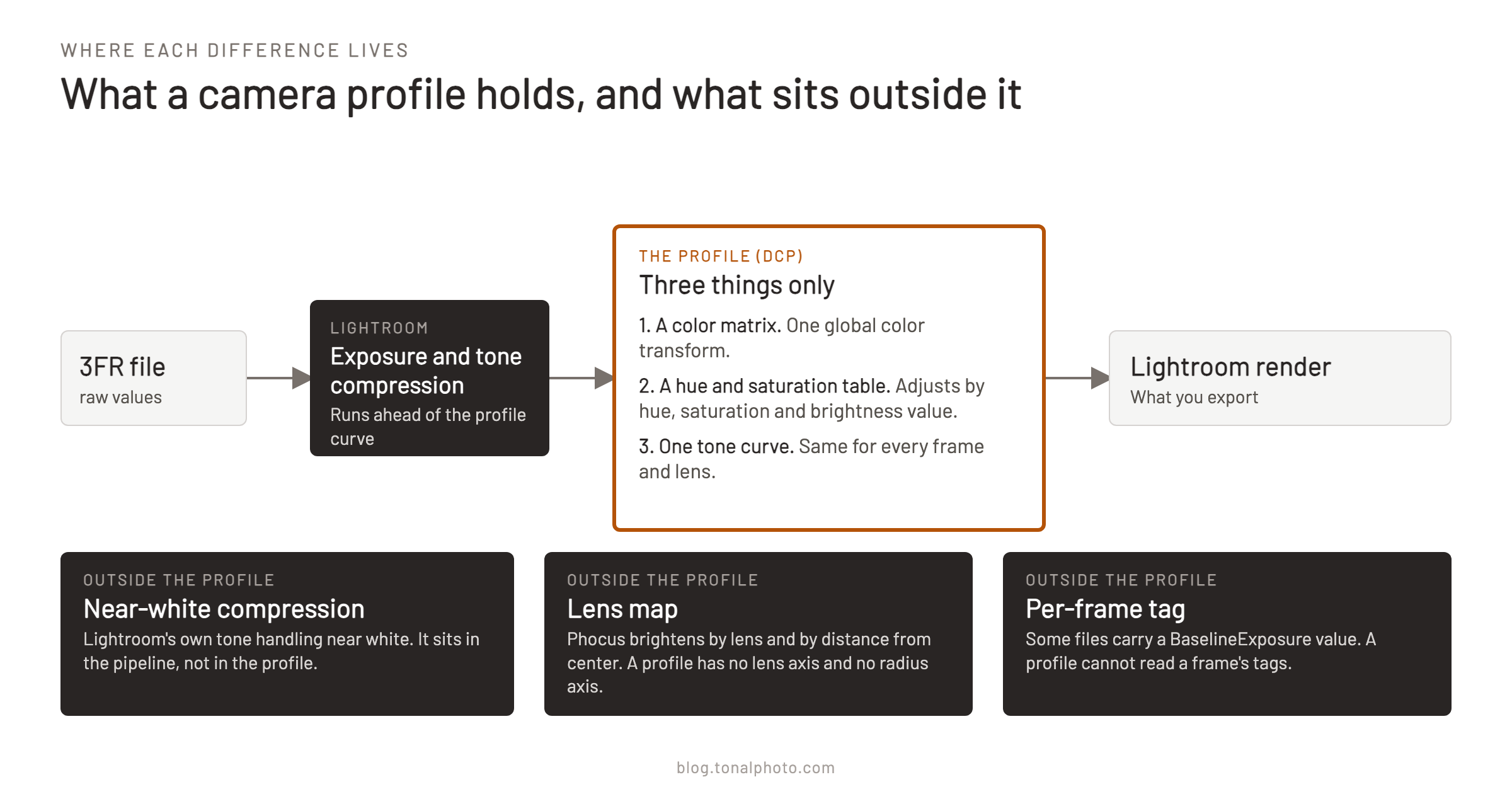
Figure 2. What the profile holds, and the three places a difference can live outside it.
How close does it get to Phocus?
On 57 frames I shot with the XCD 90V after the profile was fitted, frames no fit had seen, the median difference from Phocus 4.2.3 is 0.94 dE2000. One frame in ten scores under 0.55, and one in ten over 1.19. I exported them from Lightroom Classic 15.6 and compared both renders in blocks across the frame center.
Two other sets, with different scope:
- Pushed frames. Twelve XCD 25V frames, both apps pushed +2 EV, scored 0.89 to 1.46 per frame.
- A year of archive. On 189 archive frames across nine lens settings, an earlier version of the profile scored 1.65 in real Lightroom. Since then a brightness correction predicts about 1.0, from a simulation that tracked real exports to a median of about 0.4 dE. I have not re-exported the archive with 1e, so that is a prediction.
Every score here uses one scope: frame center, smooth unclipped areas, Phocus's Standard response, as-shot Daylight white balance, lens corrections off in both apps. Phocus's own Standard import preset sets Vignetting to 100, which I covered here. These renders did not use it.
The 2.4 from July and the 0.94 are not the same test. The 2.4 came from printed chart patches at matched brightness, the 0.94 from real frames without matching, so the two numbers are only a rough scale.
What no profile can carry
Everything in this section sits outside what a profile holds, and each item has its own page.
Phocus brightens by lens and by position in the frame
With lens correction off, Phocus still lifts the frame by lens. On the XCD 55V the lift runs from -0.03 EV at the center to +0.67 EV at the edge. On the 90V it runs from +0.09 EV to +0.29 EV. Lightroom applies nothing there, so 90V frames read dark: a median of 0.56 L* with 1e. L* is lightness on a scale from 0 to 100. With the earlier profile version the lens showed in the scores, 0.97 median on the XCD 135 and 2.08 on the 90V.
Turning Lightroom's lens profile on moved both lenses closer to Phocus in brightness, but Adobe's 55V profile overshoots, and I have not scored the 90V set that way. The full measurement is on its own page.
Some files carry an exposure tag
Thirty-seven of 300 archive frames carry a nonzero BaselineExposure tag. Thirty-four are +0.086 EV and all at ISO 1600, and a few are +0.5 or +1.0. Both apps apply the tag. On 5 of the 7 tagged frames I exported, Lightroom added another +0.20 to +0.26 EV on top. My hypothesis is that Lightroom drops a hidden -0.20 EV offset when the tag is present; two frames do not fit. Tagged frames scored a median 3.64 dE2000 against 1.51 for untagged ones with the earlier profile. The tag has its own page.
Lightroom compresses near-white tones
On neutral ladders shot with the 90V at f/8, Lightroom matches Phocus within about 0.4 L* up to raw level 0.6. Raw level is the sensor value before rendering, 0 at black and 1 at clipping. Above 0.6 Lightroom renders darker: 1.9 L* at 0.6 to 0.7, 2.4 at 0.7 to 0.8, and about 3 from 0.85 to 0.95. Three ladders agreed within 0.25 L*, but they are one lens and one card, and above 0.8 each rests on two frames or fewer. The measurements fit a compression that runs before the profile's curve. The ladders and the lever tests are on their own page.
Pushed frames lose a little chroma
C* is chroma, how far a color sits from gray. On the 12 pushed 25V frames, Lightroom had about 1 C* less chroma than Phocus in every frame. At the meter, on 90V frames, the same measure was a third as large and not consistent. Lens and scene mix are confounded with the push, so I cannot say the push causes it. A saturation boost to cover it would overshoot about a third of the at-meter frames. A same-scene test at the meter and two stops under is planned.
What I chose not to fix
I built a curve change that lifts near-white tones toward Phocus. It would also desaturate them. The simulation predicts near-white neutrals getting 0.86 dE worse on the f/8 ladder and 1.55 worse on the f/2.5 set. The color number is the least certain in the chain, but it was enough. I put color before lightness, so 1e stays as it is. Whites land 2 to 3 L* darker than in Phocus.
Where the measurements stop
Saturated color near clipping. On one ColorChecker bracket with the XCD 55V, bright unclipped cyan sat 12.6 dE2000 from Phocus and magenta 10.7, at raw level 0.85 and up. Two frames two to three stops over scored 5.1 and 5.6. No version of the profile has been fitted on blocks that close to clipping. On real frames that region is specular and near-specular color, and because I shoot about two stops under the meter I rarely land there.
White balance below 4500 K. A Phocus Kelvin sweep on one chart frame, fitted with a matrix-only model, showed a single fixed transform tracking within about 0.3 dE of a separate fit per setting from 4500 to 8000 K, and falling behind outside it. I have not shot a tungsten scene. Five archive frames with non-Daylight as-shot white balance scored a median 1.42, from 0.76 to 4.92, which is too few to read.
Skin and warm light. No scoring exists.
Everything else. Frame edges (2.40 across all radii against 1.65 at the center, earlier version), ISO above 1600, other Phocus responses and edited white balance were not tested. In the 90V set, 47 of 57 frames are ISO 50.
What to do about it
Hold any profile, mine included, to this sheet before you trust its number:
- Camera. Mine matches X2D II files only.
- Lens. The XCD 90V is the only lens with a fresh-frame score in real Lightroom. Other lenses are archive estimates.
- White balance. Measured from 4500 to 8000 K, on one chart frame. Use As Shot.
- Response. Standard.
- Lightroom version. Classic 15.6.
- Lens corrections. Off when the number was measured. A score taken with the lens profile on is a different test.
- Region. Frame center, smooth unclipped color. Not edges, near-clip color or skin.
- Sample. Ask for the number of frames and the spread, not only the median.
Two settings follow from the record. If you shoot ISO 1600, check a file's tag with exiftool -BaselineExposure file.3FR. It reads 0 on the untagged frames I checked; tagged ones should come out about 0.2 EV brighter in Lightroom than in Phocus. With the 90V, the center lift in Phocus is +0.09 EV, so about +0.1 EV in Lightroom brings it level. That figure comes from close-focus wall frames at f/8, not landscape distances.
Two measurements are still owed. The first is near-clip captures: frames that put saturated color within a stop of clipping, so the profile can be fitted and scored there. The second is a skin and warm-light set, which is the one most portrait shooters would want to see.
References
- Phocus, Capture One or Lightroom: I Measured Instead of Guessing, Tech Behind the Frame, July 2026.
- What You Keep and Lose When You Skip Phocus, Tech Behind the Frame.