Open the same X2D II 3FR in Phocus and in Lightroom Classic. Switch lens correction off in Phocus and leave Lightroom's lens profile off. Lightroom's version has darker corners, and with some lenses it is darker everywhere.
I measured this on a flat wall with two lenses. At the center of the frame, XCD 55V files came out of Lightroom within 0.4 L* of Phocus, and XCD 90V files 0.6 to 1.1 L* darker. L* is the lightness scale color software uses, 0 for black to 100 for white. The Lightroom side was Lightroom Classic 15.6 with my own work-in-progress camera profile, which is not available to anyone yet. The Phocus side was 4.2.3.
With lens correction off, Phocus still brightens the frame by an amount that depends on the lens and on the distance from the center. Lightroom does not.
A note on support: This post represents my personal exploration and testing, not official technical support or guidance from Hasselblad. If you need assistance with your Hasselblad equipment, please contact Hasselblad directly: customersupport@hasselblad.com for global support, support.us@hasselblad.com for the Americas, or visit hasselblad.com/support for regional options.
Key finding: In Phocus 4.2.3 with lens correction off, an XCD 55V frame is brightened from -0.03 EV at the center to +0.67 EV at the edge, and an XCD 90V frame from +0.09 EV to +0.29 EV, against the raw data. Lightroom Classic adds none of it. Two lenses, one wall, close focus.
Phocus lifts a 55V frame by 0.67 EV at the edge and a 90V frame by 0.29 EV
On 28 October 2026 I shot ten frames from a tripod, all of one flat, evenly lit wall: five shutter speeds from 1/6 s to 3 s with the XCD 90V, then the same five with the XCD 55V. Aperture f/8, ISO 50, Daylight white balance. I compared Phocus's output with a calculated render of the same raw data that has no lens gain in it, block by block, grouped by distance from the center. Real Lightroom exports with profile corrections off track that calculation in every bin. EV is a stop of exposure: +1 EV is twice the light.
| Lens | Center | Radius 0.3 to 0.4 | Radius 0.55 to 0.7 | Edge |
|---|---|---|---|---|
| XCD 55V | -0.03 | +0.05 | +0.28 | +0.67 |
| XCD 90V | +0.09 | +0.13 | +0.21 | +0.29 |
Table 1. Brightness Phocus 4.2.3 adds with lens correction off, in EV, compared with the same raw data. The four dimmer frames per lens (1/6 s to 1.4 s). Radius: 0 is the center of the frame, 1 is the corner.
The 55V map is close to neutral at the center and climbs steeply. The 90V map starts above zero, so it lifts the whole frame by about 0.09 EV, and then climbs gently. Lightroom applies neither, so 90V frames read dark against Phocus while 55V frames do not:
| Shutter | 55V | 90V |
|---|---|---|
| 1/6 s | +0.01 | -0.63 |
| 0.3 s | +0.03 | -0.92 |
| 0.7 s | +0.12 | -1.06 |
| 1.4 s | +0.36 | -1.08 |
| 3 s | -0.91 | -0.18 |
Table 2. Lightroom Classic 15.6 minus Phocus 4.2.3, in L*, center of the frame (radius under 0.4), lens corrections off in both. The 55V frame at 3 s sits near clipping, and its -0.91 is highlight handling, not the lens.
On the reading I fixed before any render, that is a lens effect and not a tone effect: the 90V-minus-55V difference had the same sign in four of five pairs, with a median size of 0.95 L*. On the 3 s frames the gain shrinks. Highlight compression after the gain would do that, but I have not tested it.
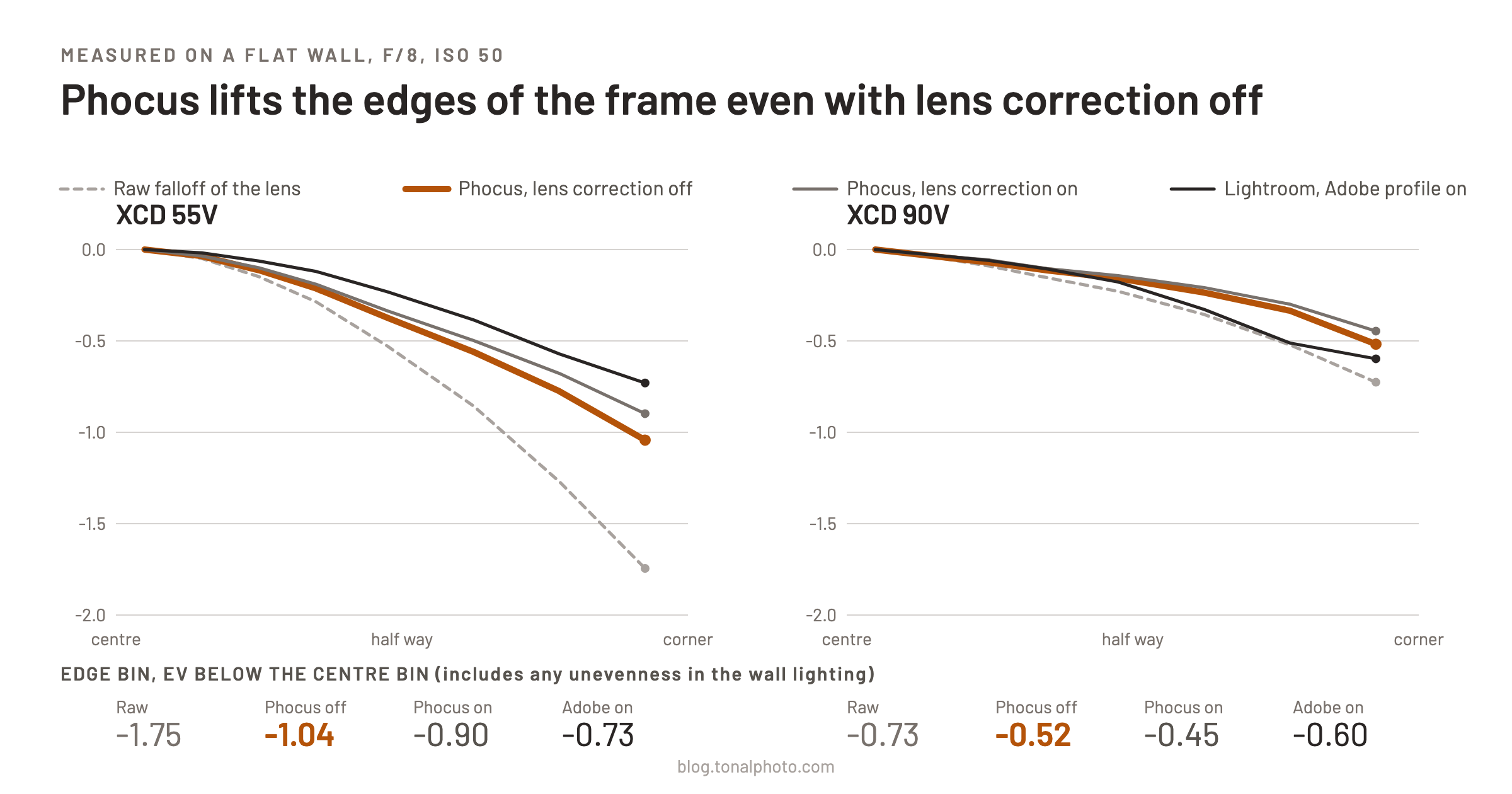
Figure 1. Brightness relative to the center bin, by radius, four frames per lens (1/6 s to 1.4 s), f/8, ISO 50. The edge values include any unevenness in the wall's lighting.
On the 55V, the raw data falls 1.75 EV from center to edge and Phocus with correction off shows 1.04. On the 90V the raw falloff is 0.73 EV and Phocus shows 0.52. Lightroom with its profile off tracks the raw falloff.
The Vignetting amount does not control it
My first guess was Phocus's Vignetting amount. The test renders had it at 12, so I re-rendered all ten frames at 0 and read the value back from each .phos sidecar. Every radius bin came out identical, to 0.000 EV. With lens correction off, the Vignetting amount changes nothing.
With lens correction on, it does act. At 12 it adds up to 0.15 EV at the 55V edge and 0.08 EV at the 90V edge. At 0 it adds almost nothing (within 0.004 EV on the 55V, 0.02 EV on the 90V). Most of Phocus's falloff correction on these frames is the part that stays on with correction off.
Two limits. Phocus's Standard preset sets Vignetting to 100, as I described in the import preset post, and I did not test 100 here. And with correction on, Phocus enlarges the 90V image by 2.75 percent (the 55V by 0.25 percent), which moves the blocks I compare. That adds up to about 0.1 EV of uncertainty to the 90V's outer-bin numbers with correction on.
Adobe's profile correction overshoots on the 55V and leaves the 90V's middle dark
I exported the same ten frames from Lightroom Classic 15.6 with Enable Profile Corrections on, Distortion and Vignetting at 100. I checked each file's embedded settings to confirm the Adobe profiles for the XCD 55V and XCD 90V were applied, because two earlier exports silently had no profile.
Corrections on moved Lightroom closer to Phocus on both lenses. Summed over the radius bins, the median lightness gap fell from 20.1 to 17.3 L* on the 55V and from 12.4 to 8.9 L* on the 90V. The remaining gaps differ by lens:
- XCD 55V. Adobe's correction lifts the edge by about 1.0 EV. Phocus with correction off lifts it by about 0.7 EV and with correction on by about 0.85. In lightness terms, on the 0.7 s frame pair, I estimated Phocus with correction off at roughly half to 60 percent of Adobe's lift in the outer bins.
- XCD 90V. Adobe normalizes to the center, so the center of the frame stays about 0.7 L* below Phocus, which lifts it. Between radius 0.55 and 0.85 the gap stays at 2 to 3 L*, so the profile barely corrects the middle of the frame.
One caution. The camera wrote Infinity as the focus distance on these close-focus frames, so Lightroom applied the profile's infinity entry, not the 0.67 m one. That is a separate firmware problem, covered in the focus distance post. On the 90V, the vignetting Lightroom applied differed from Adobe's infinity entry by 0.007 EV rms and from its 0.67 m entry by 0.088 EV rms.
Why can't a camera profile fix this?
A camera profile, the file you pick in Lightroom's Profile browser, maps colors and tones. Every pixel goes through the same map, center or corner, and the map does not know which lens was on the camera. The gain above depends on both, so a profile, including the one I built, has no axis along which to carry it.
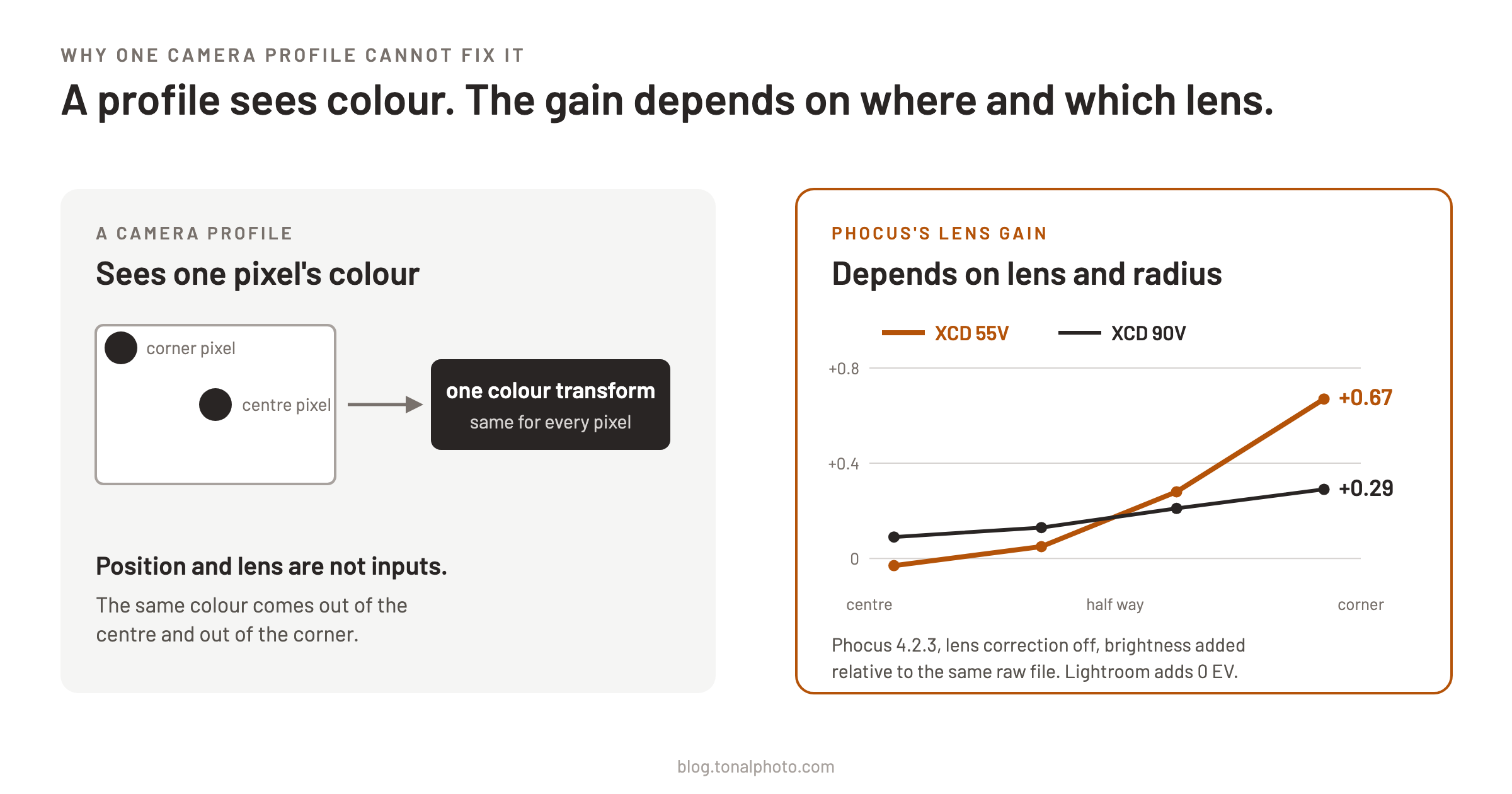
Figure 2. What a camera profile can express, and the gain Phocus 4.2.3 adds with lens correction off. The gain values are the ones in Table 1.
What this test does not cover
- Two lenses on the wall, one 25V frame. Every other lens is unmeasured.
- Close focus. The 90V frames were at its minimum focus distance of 0.67 m, the 55V frames at about 0.6 m, estimated from the focus data in the files.
- One wall, one light, f/8. On 90V outing frames, mostly at f/5.6, Lightroom read only 0.56 L* dark, against 0.6 to 1.1 here. Aperture dependence is untested.
- Mechanism. I do not know how Phocus produces this gain, and the edge values include any unevenness in the wall's lighting.
- A separate effect. At the same f/8 and shutter speed, the 90V delivered about 0.5 EV less light at the sensor center than the 55V. I could not separate lens transmission from flare in the 55V's wider view.
What to do about it in Lightroom Classic
In the Lens Corrections panel, open the Profile tab and tick Enable Profile Corrections. On both lenses that moved Lightroom closer to Phocus.
- XCD 25V: set the Vignetting amount to 50. On one 25V frame (f/11, ISO 100, 1/20 s), Lightroom at the default 100 lifted the zone between 0.7 and 0.8 of the radius by 1.24 stops, against 0.64 for Phocus with lens correction on. At 50, Lightroom's lift was half the 100 value and landed within 0.07 stop of Phocus at every radius. The corners stayed about 4 to 5 percent cooler than Phocus, which the slider cannot fix. Open Setup in the same panel and choose Save New Lens Profile Defaults to store the value for that lens.
- XCD 90V: add about +0.1 EV to the exposure. The measured gain at the center of the frame, over the calculated render, was 0.08 to 0.12 EV across the four dimmer frames. I derived the nudge with corrections off. I have not scored it with corrections on, and with corrections on the center of a 90V frame still read about 0.7 L* below Phocus in the same test.
- XCD 55V: expect Adobe's correction to overshoot. I estimated that a Vignetting amount of 50 to 60 would land nearer Phocus. I have not tested a value.
Not yet done: scoring the 90V exports with corrections on, and repeating the wall test at f/5.6.
This page is one of four from the same profile project. The summary, with every limit on one sheet, is What a Lightroom camera profile can and cannot reproduce from Phocus.