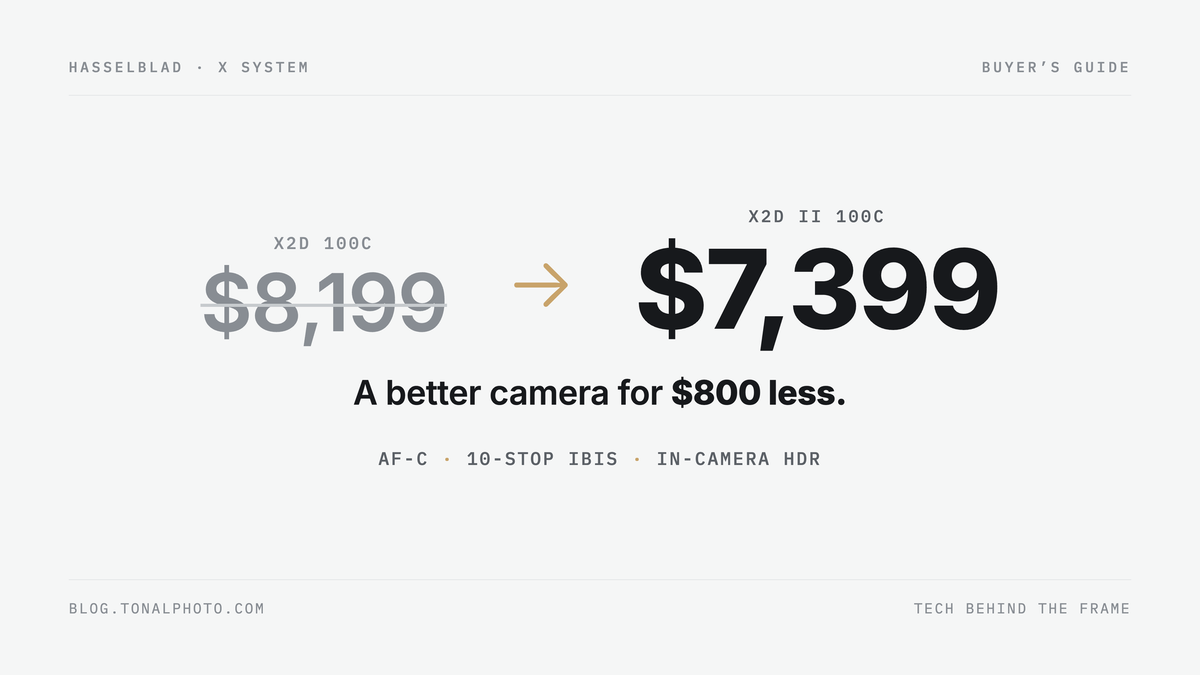
Hasselblad did something unusual with the X2D II. It replaced an $8,199 camera with a better one and charged $800 less.
The X2D II 100C launched at $7,399, undercutting the X2D 100C it succeeded.¹ That older camera is now discontinued, marked on Hasselblad's own store as "succeeded by its next evolution."² So for anyone shopping medium format today, the 100C is off the table, and the real question is whether the X2D II earns its price.
I shoot the X2D II. Here is what actually changed, what didn't, and where it still falls short.
Key finding: The Hasselblad X2D II adds continuous autofocus with subject detection, 10-stop stabilization, and in-camera HDR to the same 100-megapixel sensor as the X2D 100C, for $7,799, still less than the $8,199 the 100C sold for. The autofocus is a real upgrade, not a sports system. It is worth it for deliberate medium format work, and wrong for fast action.
Pricing note: The X2D II launched at $7,399; on June 30, 2026, Hasselblad raised it to $7,799, citing supply chain costs.¹ Even at the new price it stays $400 under the discontinued 100C's $8,199. A cheaper successor is unusual, and Hasselblad has not explained the launch price; landing just below the $7,499 Fujifilm GFX100 II is the obvious competitive read.
X2D, X2D 100C, X2D II 100C: which name is which?
The model names cause real confusion. Hasselblad's full names are X2D 100C (released 2022, now discontinued) and X2D II 100C (released 2026). Both carry the 100C suffix because both are built around a 100-megapixel sensor. X2D II and X2D II 100C are the same camera; there is no separate model without the suffix.
So "X2D vs X2D II", "X2D 100C vs X2D II", and "X2D 100C vs X2D II 100C" all describe the same comparison: the 2022 camera against its 2026 successor. That is the comparison this post covers.
What actually changed from the X2D 100C?
Four things moved: focusing, stabilization, in-camera HDR, and the body itself. The sensor at the center of the camera did not, which matters for how you read the rest of this.
| Spec | X2D 100C | X2D II 100C |
|---|---|---|
| Price (US) | $8,199, now discontinued | $7,799 (launched at $7,399) |
| Sensor | 100MP 44x33mm BSI CMOS | Same sensor family |
| Autofocus | Single-shot only, 294 PDAF zones | AF-C with subject detection, 425 PDAF zones |
| In-body stabilization | 7 stops (CIPA) | 10 stops at center, 8 at edges (CIPA) |
| In-camera HDR | No | Yes, single exposure (Ultra HDR JPEG, HDR HEIF) |
| Rear screen | 3.6-inch TFT, tilting | 3.6-inch OLED, tilting, 1400 nits, D65 |
| Body weight | 790 g | 730 g |
| Low ISO | 64 | 50 |
| Guaranteed software updates | Through 2026 | Through 2028 |
Autofocus (AF-C): the first Hasselblad that tracks
The X2D II is the first Hasselblad that can recognize a subject and follow it across the frame. That capability is the reason most people are looking at this camera at all.
Hasselblad markets it as the first AF-C on a Hasselblad. That overstates it: the H-System already offered a "Continuous" focus mode (AF C) that kept refocusing on whatever sat in the center zone. The genuine first is subject detection, the camera locking onto a face or an eye and holding it through the shot.
The hardware behind it grew. Phase-detection coverage went from 294 zones on the X2D 100C to 425 zones spread across the full sensor. A deep-learning subject-detection system now recognizes people, vehicles, cats, and dogs, marks them on screen, and lets you pick one with the new joystick. There is a LiDAR module that helps the camera find focus in low contrast and low light by narrowing where it looks, plus a front AF-assist illuminator that doubles as the self-timer light. Four focus-area modes replace the old single point: Spot, Expand Spot, Custom, and Wide.
In practice it focuses confidently on static and moderately paced subjects: a portrait sitter who shifts their weight, a slow pan across a market stall. This is the medium format autofocus Hasselblad shooters have wanted for years, with limits worth being honest about. Shooting a walking person, I get critical sharpness where it matters on maybe 20 to 30 percent of frames. That is the honest figure, not a flattering one. It climbs noticeably when the subject's eye stays visible through the sequence, which is where the detection earns its keep. For deliberate frames that hit rate is fine. For a running dog or a child sprinting across a lawn, it is not.
It trails a Sony A9 or Canon R3 on speed, and Hasselblad has been upfront about that. Continuous AF tops out around 3 frames per second with autoexposure and tracking active. Early testers flagged a startup lag on the first frame of a continuous burst; Jim Kasson called it initially shocking.³ On the current firmware I do not notice it as a real problem. No one is buying an X2D II to shoot it like a Sony A9 III anyway.
That's a different number from the X2D 100C's rated 3.3 fps, and the two cameras handle bit depth in continuous mode differently too. I've dug into the 100C's continuous-shooting specs, including what Hasselblad does and doesn't publish about buffer depth, in a separate post.
Which XCD lenses support AF-C?
This is the one buying trap to know before you spend anything. AF-C only works on a short list of lenses with current firmware: the 35-100E zoom, the four V-series primes (25, 38, 55, 90), and two P-series primes (28 and 75). The original-generation XCD lenses do not support it, and neither does the 20-35E, which is the most expensive zoom in the lineup. If continuous autofocus is your reason to buy, check your glass first. I cover the full compatibility list in the XCD lens guide.
In-body stabilization (IBIS): 7 stops to 10
In-body stabilization went from a rated 7 stops on the X2D 100C to 10 stops on the X2D II, measured by Hasselblad under the CIPA standard with the 120mm macro.⁴ The figure is 10 stops at the center of the frame and 8 at the edges. Hasselblad frames it as up to eight times the safe handheld shutter speed of the previous body.
Here is what that looks like in my hands. I hold two seconds handheld without much trouble, and I have kept shots sharp around the three-second mark, while watching clear movement in the finder, the kind that would wreck the shot on any other system I have used. That gain is real and it is large. What stabilization cannot do is freeze a subject: a person or a branch moving laterally will blur no matter how many stops the body claims, because sensor-shift corrects your movement, not theirs. For static scenes handheld, the 10-stop rating is not just a lab number.
The stabilization system also has a lesser-known dependency: Earth Rotation Compensation, which needs a GPS fix from Phocus Mobile 2 so the gyros stop misreading the planet's rotation as hand shake during long handheld exposures: The 4-Hour Location Window.
In-camera HDR, the Hasselblad way
The X2D II can output HDR images straight from the camera. This is where the most confusion lives, so here is what the camera actually does.
The X2D II's HDR is single-exposure: one RAW frame, no bracketing or merging. Traditional in-camera HDR on a Sony or Canon combines several exposures; Hasselblad does not. Turning on HDR mode does two things: it biases the meter to protect highlights, and it writes an HDR-encoded file alongside the RAW, carrying the extended luminance through a gain map for Ultra HDR JPEG or PQ encoding for HDR HEIF.⁵
The wide dynamic range was always in the RAW. That means any X2D II RAW, shot with HDR mode on or off, can be rendered as an HDR image later in Phocus or Phocus Mobile 2. The in-camera toggle is a convenience for delivering an HDR JPEG without a desktop, not a different capture. One caveat for delivery: HDR HEIF only displays correctly on the X2D II itself and in Phocus, so for sharing, the Ultra HDR JPEG is the format that travels. I walk through the full output picture in the Hasselblad HDR guide.
Researching and writing the blog and page posts I produce takes up a lot of my time and costs me money for software subscriptions, tooling, and other incidentals related to running a business.
Please consider a paid membership to help me keep the lights on and pay the bills - it is only a fraction of the cost of an X2D II and a lens. Click on the button to go to the membership page to see the options available.
The body: screen, joystick, weight
The rest of the changes are ergonomic, and they add up. The rear screen moves from the 100C's TFT to a 3.6-inch OLED that tilts two ways (roughly 90 degrees up, 43 down) and peaks at 1400 nits. It is calibrated to a D65 white point, the neutral reference that phone and computer displays target too. If your files look slightly cooler on the X2D II than they did on a 100C, that is the screen calibration, not the sensor.⁴
A five-way joystick now sits beside the screen for moving the focus point, which the 100C lacked (more on the control layout and custom profiles). The body dropped from 790 to 730 grams, about 7.5 percent lighter, and gained a stop of low ISO (down to 50). Small things, but they are the things you feel on a long day. One addition that is easy to miss: the X2D II gains a 3.5mm shutter control port the original 100C never had, which is what lets you drive it with a wired remote or a generic trigger, as covered in Triggering the X2D II with a MIOPS Smart Trigger.
What hasn't changed?
The sensor. Both cameras use the same 100-megapixel 44x33mm BSI CMOS at their core; Hasselblad calls the X2D II version enhanced, but it is the same family, not a new chip. You also keep the 1TB internal SSD plus CFexpress Type B, and the same 3FR-to-Phocus workflow with HNCS color science applied at render time. If you already know how a 100C file behaves in Phocus, an X2D II file behaves the same way once it is on disk. One quiet bonus: Hasselblad's guaranteed software-update window runs to the end of 2028 for the X2D II, versus the end of 2026 for the 100C.
What the X2D II still doesn't do well
A fair verdict names the gaps.
Continuous autofocus is built for deliberate shooting, not motion. As covered above, a walking subject is hit or miss, burst speed stays around three frames per second, and the LiDAR focus assist only reaches about five meters.³ This is not a wildlife or sports body. The AF-C lens whitelist also locks out the original primes and the priciest zoom. And in continuous drive the camera silently drops from 16-bit to 14-bit RAW with no on-screen warning, because the file container stays the same size either way; I explain when that actually matters in a separate post on the 14-bit switch.
One number deserves context. Hasselblad markets 15.3 stops of dynamic range. Jim Kasson's independent testing measured around 12.5 stops of photographic dynamic range, which is the usable range before noise dominates, a stricter and more practical metric than the headline figure.³ Both numbers are real; they measure different things. The camera has excellent dynamic range. It does not have three extra stops over its competitors hiding in a spec sheet.
How much of that range you actually pull from the shadows depends on the scene and on how Phocus works. Its shadow tool lifts a broad band of low midtones and shadows together rather than digging selectively into the blacks the way Capture One does. A landscape where the shadows are dark but not crushed opens up beautifully. Trying to isolate a subject by lifting only its shadows is harder, because the background usually sits in the same tonal range and comes up with it. That is a Phocus characteristic, not a sensor limit, and I dig into it in the shadow fill and highlight recovery post.
What about the Fujifilm GFX 100 II?
The honest cross-shop is Fujifilm, not Hasselblad's own back catalogue. The Fujifilm GFX100 II carries a 102-megapixel sensor in the same class and lists around $7,499, almost level with the X2D II. Its smaller sibling, the GFX100S II, drops to about $5,000. Fujifilm's G-mount lineup is broader and generally cheaper than XCD glass, and the GFX bodies shoot video up to 8K. The X2D II shoots no video at all.
So why pay the same or more for fewer lenses and no video? Three reasons hold up. HNCS color science and the Hasselblad Film Curve, which you only get by rendering through Phocus. The leaf shutter in every XCD lens, which syncs flash at shutter speeds a focal-plane body like the GFX cannot reach, covered in the flash and TTL guide. And the single-box workflow, with a 1TB SSD built into the body and no cards to shuffle. If none of those three matter to you, the GFX is the rational buy, and I would not argue.
So is it worth it?
The X2D II is worth it for landscape, portrait, studio, and architecture photographers who shoot considered frames rather than chase action. It costs less than the 100C it replaced, adds the continuous autofocus the X2D line never had, and the stabilization gain is real. The in-camera HDR is a genuine convenience once you understand it is a single-exposure feature, not a bracketing mode.
It is the wrong camera for fast action, wildlife in motion, or sports. No firmware update will change the three-frames-per-second ceiling or the medium format readout behind it. If that is your work, buy a different system and be happier.
If you are weighing it against a GFX, the question comes down to whether HNCS color, the leaf shutter, and the single-box workflow are worth paying the same money for fewer lenses and no video. For me they are. For you they might not be, and that is a fair answer too.