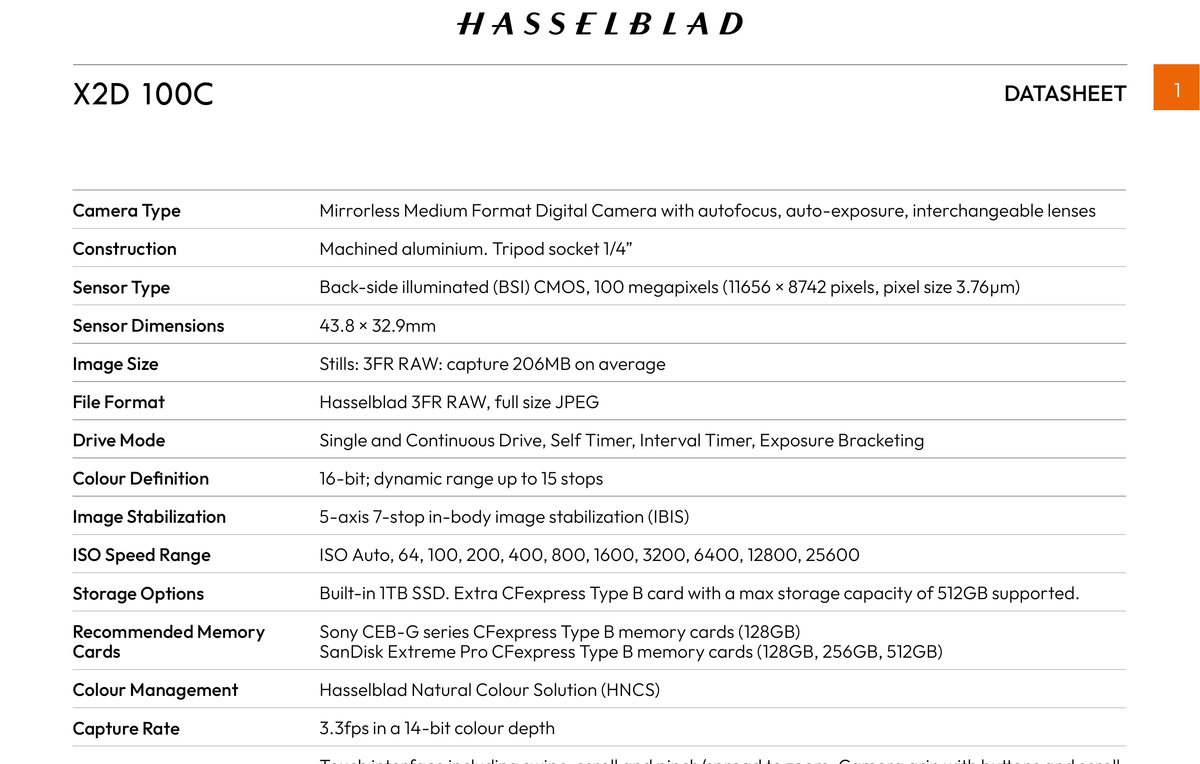
Search for the X2D 100C's RAW bit depth or its continuous shooting buffer and Google mostly hands you an article about a different camera. The Hasselblad X2D II shares a sensor lineage with the original X2D 100C, but the two bodies handle continuous shooting differently enough that specs for one don't transfer to the other.
This post is about the original X2D 100C, the 2022 camera that brought Hasselblad's 100-megapixel BSI sensor to the X System and introduced the company's first in-body stabilization. The naming deserves a warning, because Hasselblad made it genuinely confusing: the newer camera's full official name is X2D II 100C (that is what the EXIF in its files says), so both bodies carry "100C" in their names. If your camera has the II, this post's specs are not your specs. If you shoot the newer X2D II, its continuous-mode bit depth behavior works differently, and I've covered that separately.¹
Key finding: Hasselblad's datasheet lists the X2D 100C's continuous rate as 3.3 fps in 14-bit. Unlike the X2D II, its FAQ and product page describe 16-bit as available in Continuous Drive Mode too, just not at that peak rate. Hasselblad publishes no buffer-depth figure in frames.
The X2D 100C's RAW Bit Depth: 16-Bit, Up to 15 Stops of Dynamic Range
The X2D 100C's baseline RAW capture is 16-bit. Hasselblad's official datasheet lists the camera's "Colour Definition" as "16-bit; dynamic range up to 15 stops."² The sensor is a 100-megapixel back-side illuminated (BSI) CMOS unit, 43.8 x 32.9mm, producing 11656 x 8742-pixel files at a 3.76-micron pixel pitch.²
Sixteen-bit color depth gives you 65,536 tonal levels per channel, versus 16,384 for 14-bit. Hasselblad's own FAQ frames the comparison directly: "16-bit colour depth can deliver 281 trillion colours, 64 times higher than 14-bit."³ That's the marketing framing. Whether the extra two bits are visible in a finished image is a separate question, one I've addressed at length for the X2D II's sensor generation, and the physics argument (sensor noise floor exceeds what 14-bit versus 16-bit quantization can resolve) applies here too.¹
What the Datasheet Says About Continuous Shooting: 3.3 fps at 14-Bit
Hasselblad's official X2D 100C datasheet lists a single line for burst performance: "Capture Rate: 3.3fps in a 14-bit colour depth."² That's the number you'll see repeated across spec aggregators and comparison charts, and it's accurate as far as it goes. Hasselblad ties its rated peak continuous shooting speed to 14-bit capture specifically.
What the datasheet doesn't say is whether 14-bit is mandatory in Continuous Drive Mode, or just the setting that gets you the fastest number on the spec sheet. For that, you have to read the FAQ and the product page, and they tell a different story than you might expect from the X2D II.
Researching and writing the blog and page posts I produce takes up a lot of my time and costs me money for software subscriptions, tooling, and other incidentals related to running a business.
Please consider a paid membership to help me keep the lights on and pay the bills - it is only a fraction of the cost of an X2D II and a lens. Click on the button to go to the membership page to see the options available.
Does Continuous Drive Mode Force 14-Bit on the X2D 100C?
No. Unlike the X2D II, where selecting Continuous drive mode grays out the 16-bit option entirely,¹ the X2D 100C treats bit depth as a setting you choose, not one the camera forces on you when you switch drive modes.
Hasselblad's X2D 100C FAQ answers the question "When should I use 14-bit and 16-bit colour depth?" directly: "Choose 14-bit colour depth to keep outstanding colour while increasing the continuous shooting rate. Use 16-bit to increase the number of tonal nuances in colour for natural transitions."³ That phrasing treats 14-bit and 16-bit as a live tradeoff you make, available regardless of drive mode, not a setting that vanishes the moment you pick Continuous.
The product page is more explicit still. Describing the camera's built-in SSD, Hasselblad writes: "Thanks to its high-speed storage performance, the X2D 100C is able to continuously shoot 16-bit RAW images in Continuous Drive Mode, providing a stable and reliable continuous shooting experience."⁴ That sentence reads as an implicit comparison to older or slower medium format bodies that couldn't sustain full bit depth during a burst, framed as a selling point built around the internal SSD's write speed.
Here's how I read the three sources together, and this reconciliation is my inference, not a direct Hasselblad statement: the 3.3 fps figure in the datasheet is the ceiling you get specifically at 14-bit. Choosing 16-bit in Continuous mode is possible on the X2D 100C, but Hasselblad doesn't publish what frame rate you get when you do. Given that reading and writing more data per frame takes longer regardless of camera, it's reasonable to assume 16-bit continuous shooting comes in below 3.3 fps, but I have not tested this myself and Hasselblad has not published a number for it. Treat the sub-3.3-fps assumption as informed speculation, not a spec.
If you own an X2D 100C and have measured your actual continuous shooting rate at 16-bit, I'd like to hear about it.
Have you seen the guide? I've published Essential Phocus 4.x for Mac - 85 topics across 8 sections and 251 pages covering everything from HNCS color science to HDR workflows. It's the reference manual Hasselblad hasn't updated since 3.8. It's $49, and updates are included.
What Is the X2D 100C's Continuous Shooting Buffer Depth?
Hasselblad doesn't publish one. I checked the official datasheet, the FAQ, and the product page for a buffer depth figure, meaning how many consecutive RAW frames the X2D 100C can capture before the frame rate drops. None of the three states one.²ˎ³ˎ⁴
What Hasselblad does publish is the infrastructure behind the buffer. The X2D 100C's built-in 1TB SSD writes at up to 2,370MB/s and reads at up to 2,850MB/s.² That's the number Hasselblad points to when explaining why the camera can sustain continuous shooting at all: fast enough internal storage that the buffer clears quickly rather than filling up and stalling the camera. But sustained write speed and buffer depth in frames are two different specs, and only one of them is on the datasheet.
If precise buffer depth matters for your shooting (sports, wildlife, anything requiring long bursts), Hasselblad's own materials won't tell you the number. You'd need to test it yourself with a stopwatch and a memory card, which I have not done, since I don't own this camera.
RAW File Size and Storage
A single X2D 100C RAW capture (Hasselblad's proprietary 3FR format) averages 206MB, according to the datasheet's "Image Size" field.² At that file size, a 1TB SSD holds roughly 4,600 RAW-only images before it fills, a figure Hasselblad states directly in the FAQ.³ The camera pairs the built-in SSD with a CFexpress Type B card slot supporting up to 512GB of additional storage.²
None of this changes based on whether you're shooting 14-bit or 16-bit. Like most RAW containers, the X2D 100C's 3FR format appears to reserve the same storage footprint regardless of actual bit depth captured, based on the pattern Hasselblad documents for the X2D II's identical file container.¹ Hasselblad's X2D 100C materials don't state this explicitly, so treat it as a reasonable inference from the sibling camera's documented behavior, not a confirmed X2D 100C spec.
X2D 100C vs. X2D II: Two Different Answers to the Same Question
If you've read both this post and the X2D II continuous-mode piece, the difference in the two cameras' approach to continuous-mode bit depth was the actual finding.¹ Hasselblad tightened the X2D II's behavior: Continuous drive mode simply removes the 16-bit option, no exceptions, and the camera settles on a rated continuous rate around 3 fps that Hasselblad explicitly frames as measured in AF-C.
The X2D 100C predates that constraint. Its 3.3 fps rating is tied to 14-bit, but 16-bit stays selectable in Continuous mode according to Hasselblad's own FAQ and product copy, likely at a slower, unpublished rate. The 100C also lacks AF-C entirely (autofocus is AF-S only, with up to 294 PDAF zones, versus the X2D II's 425-zone PDAF and AF-C support), so "continuous shooting" on the 100C never has to account for continuous autofocus tracking the way the X2D II's rated 3 fps does.⁵
If you're weighing whether to buy the X2D 100C or upgrade to the X2D II, the bit-depth-in-burst behavior covered here is one piece of a larger picture that includes price, autofocus, and stabilization differences. I've covered that comparison separately.⁶
Bottom Line
The X2D 100C's baseline RAW capture is 16-bit, up to 15 stops of dynamic range, per Hasselblad's own datasheet. Its rated continuous shooting speed, 3.3 fps, is specifically a 14-bit figure. Unlike the X2D II, the 100C doesn't appear to force 14-bit the moment you switch to Continuous drive mode: Hasselblad's FAQ and product page both describe 16-bit as available in that mode, just not confirmed at the 3.3 fps peak.
Buffer depth in frames isn't published anywhere in Hasselblad's official materials for this camera. The closest documented figure is the built-in SSD's sustained write speed (up to 2,370MB/s), which explains why the camera can sustain bursts at all, but doesn't tell you how many frames you get before the rate drops.
References
- Hasselblad X2D II: Why Your RAW Files Drop to 14-Bit in Continuous Mode (And When It Matters), Tech Behind the Frame: covers the X2D II's continuous-mode bit depth behavior, which differs from the X2D 100C's as described in this post.
- X2D 100C Datasheet (PDF), Hasselblad: "Colour Definition: 16-bit; dynamic range up to 15 stops." "Capture Rate: 3.3fps in a 14-bit colour depth." "Image Size: Stills: 3FR RAW: capture 206MB on average." Storage write speed up to 2,370MB/s, read speed up to 2,850MB/s.
- X2D 100C - FAQ, Hasselblad: "Choose 14-bit colour depth to keep outstanding colour while increasing the continuous shooting rate. Use 16-bit to increase the number of tonal nuances in colour for natural transitions. 16-bit colour depth can deliver 281 trillion colours, 64 times higher than 14-bit." Also: "the X2D 100C can store approximately 4,600 photos" shooting RAW only on the built-in 1TB SSD.
- X2D 100C product page, Hasselblad: "Thanks to its high-speed storage performance, the X2D 100C is able to continuously shoot 16-bit RAW images in Continuous Drive Mode, providing a stable and reliable continuous shooting experience."
- Hasselblad X System Reference (internal vault note, cross-checked against the official X2D 100C and X2D II 100C datasheets): AF-C availability, PDAF zone counts, and IBIS stop ratings for both cameras.
- Hasselblad X2D II vs X2D 100C: Is the Upgrade Worth It?, Tech Behind the Frame.