For most of the X System's life, Hasselblad autofocus meant one move: lock on a half-press, recompose, shoot. The X2D II 100C is the first Hasselblad that can recognize a subject and follow it across the frame, not just lock focus once and hold it.
It also comes with limits that don't show up on the spec sheet. What follows is my understanding of how the system works, drawn from Hasselblad's datasheet and launch materials, the v1.0 manual, and time with the camera.
Key finding: The Hasselblad X2D II 100C is the first Hasselblad that recognizes and tracks a moving subject, and the first X System body with continuous autofocus (AF-C). It pairs a 425-zone phase-detection array with contrast detection and LiDAR assist, plus deep-learning subject detection for people, animals, and vehicles. Two limits catch owners out: AF-C is unavailable with the electronic shutter, and only seven XCD lenses support it.
The X System's first continuous autofocus
AF-C is the headline, and it is genuinely a first for the X System. Every X System body before the X2D II was AF-S only. The camera locks focus when you half-press and holds it there until you release, which is fine for a landscape or a studio portrait where the subject and the camera both stay put. It comes apart the moment the subject walks toward you. AF-C closes that gap by keeping the focus loop running and adjusting the focus as the distance changes.
Hasselblad's launch copy calls this the first AF-C on a Hasselblad. That overstates it. The H System offered a Continuous focus mode (AF C) decades ago, one that kept refocusing on whatever sat in the central zone. The X2D II adds the part the H System lacked: subject detection, the camera recognizing a face or an eye and tracking it across the frame. Within the X System the continuous mode is new; across all of Hasselblad, the real first is the tracking.
The hardware also grew to support it. Phase-detection coverage expanded from 294 zones on the X2D 100C to 425 on the X2D II, spread across the 100-megapixel sensor, and Hasselblad added deep-learning subject detection and a dedicated AF illuminator for low light. None of that turns a medium-format body into a sports camera. It does mean the X2D II can keep focus live on a moving subject, which its predecessor could not.
The 100C also lacks AF-C entirely (autofocus is AF-S only), which means its continuous shooting mode never has to account for AF tracking the way the X2D II's rated 3 fps does. More on the X2D 100C's continuous-shooting and RAW bit-depth specs here.
If you are weighing the two bodies, continuous autofocus is one of the headline reasons to pick the X2D II over the original. The sensor and the resolution carry over almost unchanged; the autofocus is where the generation gap actually lives. The rest of that comparison I covered in Hasselblad X2D II vs X2D 100C.
Three focusing systems: PDAF, CDAF, and LiDAR
The X2D II combines three focusing systems, and which one leads depends on the light and the subject. Hasselblad's datasheet lists all three as the camera's autofocus type.
Phase-detection autofocus (PDAF) is the primary method. The 425 zones read focus directly off the sensor and work out which way the lens needs to move, and by how much, in a single step. There is no hunting back and forth to find the direction first. That is what makes acquisition fast, and it is why continuous tracking is feasible at all: the system reads the correction in one step instead of hunting for it.
Contrast-detection autofocus (CDAF) works by hunting for peak sharpness. It is slower, because it has to move focus, measure contrast, and keep adjusting until the contrast stops improving. What it gives up in speed it returns in precision. Hasselblad lists both PDAF and CDAF on the X2D II and the two work together, though the datasheet does not spell out exactly how the camera weighs one against the other in any given scene.
LiDAR is the assist, not the lead. The infrared LiDAR sensor does not focus the lens itself. It measures how far away the subject is and narrows the range the camera has to search, so the lens hunts less, mainly in low light or on low-contrast subjects where phase and contrast detection struggle. It is also strictly short-range. Hasselblad's manual puts the LiDAR's maximum ranging distance at five meters, and notes it cannot cover the whole frame, because the lens and shade obstruct part of its view. In ordinary light, at ordinary distances, phase detection is doing the work; LiDAR is a close-range, low-light aid, not the headline the marketing makes of it. The dedicated AF illuminator helps in the same conditions, lighting the subject enough to focus in near-dark, and it doubles as the self-timer indicator.
What AF-C does, and how fast it really is
AF-C keeps the autofocus running for as long as you hold the half-press. The AF-D button does the same thing from a different control: hold it and the camera focuses continuously, independent of the shutter release. That turns AF-D into a back-button focus control, the setup a lot of action shooters prefer, because it separates focusing from firing. You drive focus with your thumb and trip the shutter only when the frame is right.
With a fixed focus point, AF-C keeps refocusing on whatever sits under that point, so a subject moving toward or away from you stays sharp as long as you keep the point on them. It does not chase a subject across the frame on its own. Move the point off the subject and focus stays where the point is. Following a subject around the frame is the job of subject detection or tracking, which shifts the active area to keep up and marks it with a box that turns green on lock. When that subject is lost, leaving the frame or passing behind something, the camera returns the point to where it started and searches again. Focus is never frozen, it is a live estimate the camera keeps revising.
On speed, Hasselblad rates the X2D II at up to 3 fps in continuous drive. The autofocus was tuned for what medium format actually shoots: deliberate work, controlled light, subjects that are not moving erratically. A portrait sitter who keeps shifting, a slow pan, an animal moving at an easy pace, that is where AF-C with eye tracking is dependable. A subject walking toward you is more hit-or-miss; I go into the keeper rates in the X2D II vs 100C comparison. It is not remotely in the same tier as a Sony A9 III or a Canon R3 for fast, unpredictable motion. The X2D II was not built to track field sports, and the 3 fps ceiling makes that plain. Early testers, Jim Kasson among them, flagged a lag on the first half-press of a continuous burst; on current firmware I do not notice it as a real problem.
How does subject detection work?
Subject detection is where the deep-learning side of the system shows up. Turn it on and the camera recognizes and tracks three categories: people, cats and dogs, and vehicles. For people it goes a step further, finding the face and then the eye and holding on them as the subject moves. The detection setting is independent of the focus mode, so it runs in AF-S or AF-C, though it matters most in AF-C where the tracking is live.
You pair subject detection with a focus-point mode, and the X2D II gives you four. Spot is a single small point you place exactly where you want focus. Expand Spot keeps that point but adds a small assist area around it. Custom is a box you size yourself. Wide lets the camera pick the subject it judges most likely within the focus area, which is the mode that pairs naturally with subject detection.
When detection finds more than one subject in Wide mode, the camera marks the one it will focus on with a grey frame outlined in white, and the others with plain grey frames. To move focus to a different subject, push the 5D joystick toward it, tap it on the touchscreen, or swipe to cycle through them. On lenses with a control ring, you can assign subject switching to the ring and turn it to step between faces. Half-press, and the chosen subject's frame turns green while the rest disappear. This is the difference between the camera guessing which person matters and you telling it.
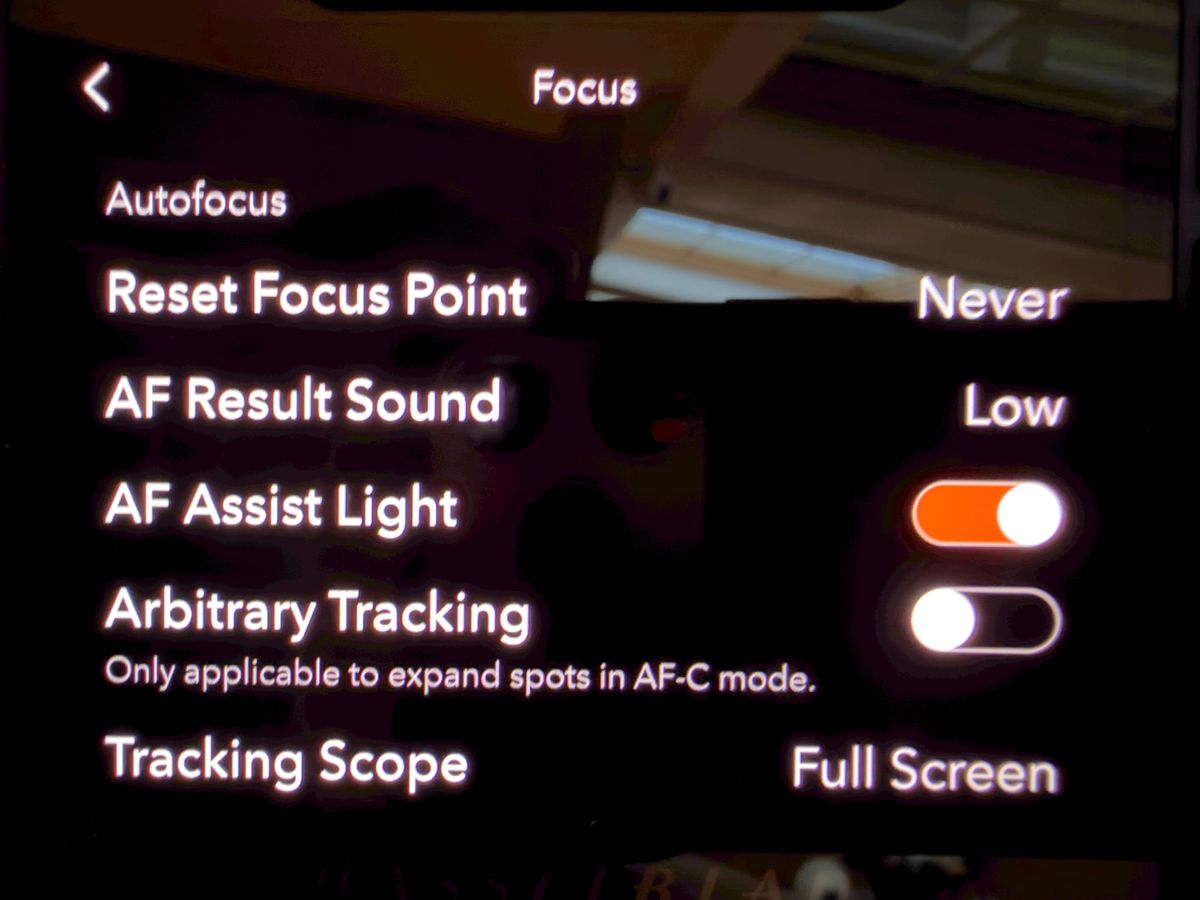
For subjects outside those three categories, the camera can do arbitrary tracking. In AF-C with the Expand Spot focus mode, it locks onto and follows whatever you place under the focus point, even something the detection model was never trained for: a moving prop, an unfamiliar vehicle, an animal that is not a cat or dog. Leave subject detection on and the camera still prioritizes its trained types, with arbitrary tracking as the fallback for everything else.
There is also Tracking Scope, which decides how much of the frame the camera searches once it is tracking. It only becomes adjustable when the focus-point mode is set to Custom; in every other mode it is locked to the full screen. Set it to Within Focus Point and the camera only hunts inside the Custom box, which lets you pre-frame a spot and wait for the subject to enter it. That is the setup for repeatable action: a runner crossing a line, a bird landing on a known perch.
The awkward part is sizing the Custom box, because choosing Custom from the Control Screen does not actually let you resize it. The resize handles only appear when you invoke the Focus Point / Subject Detection function from a button in Live View, land on Custom, and confirm it; then the control wheels set width and height. It is a two-step that is obvious once you know it and invisible until you do. Mapping that function to a custom button removes the friction, and the wider custom-button system is worth setting up once. I walk through it in Hasselblad X2D II Controls.
Researching and writing the blog and page posts I produce takes up a lot of my time and costs me money for software subscriptions, tooling, and other incidentals related to running a business.
Please consider a paid membership to help me keep the lights on and pay the bills - it is only a fraction of the cost of an X2D II and a lens. Click on the button to go to the membership page to see the options available.
The limits that aren't on the spec sheet
The spec sheet does not warn you about the parts of AF-C that actually bite.
First, AF-C is unavailable with the electronic shutter. Switch to silent shooting, for vibration-free exposures or a quiet room, and the camera disables continuous autofocus and drops you to AF-S or manual focus. Continuous tracking needs the mechanical leaf shutter, which means you hear the actuation. That is the same leaf shutter that gives the X System flash sync at every speed, which I get into in Flash and TTL on the X2D II. You cannot have silent capture and subject tracking at once, and the camera does not flag the trade. It just makes AF-C unavailable while the electronic shutter is on.
Second, AF-C works with only a specific set of XCD lenses on current firmware: the XCD 35-100E zoom, the 25V, 38V, 55V, and 90V primes, and the 28P and 75P. Mount anything else, an older XCD prime or an adapted HC or HCD lens, and AF-C is not available at all. The lens also needs current firmware, so a supported lens on an old build will not do continuous autofocus until you update it. The full lineup and where each lens sits is in The Hasselblad XCD Lens Guide.
Third, the revert is silent. Hasselblad's datasheet is the authority on which lenses qualify; mount one that does not support AF-C while you are set to continuous, and in my experience the camera drops to AF-S without a warning or an on-screen flag. You find out when the focus starts behaving differently, which is a poor time to find out. Check the mode after a lens swap.
| Constraint | What it means |
|---|---|
| Electronic shutter | AF-C is disabled; silent shooting forces AF-S or manual focus |
| Lens support | AF-C works with seven XCD lenses only (35-100E, 25V, 38V, 55V, 90V, 28P, 75P), current firmware |
| Incompatible lens | Camera silently reverts to AF-S, no warning shown |
| LiDAR range | Maximum ranging distance 5 m; does not cover the whole frame |
| Capture rate | Up to 3 fps in continuous drive |
| Subject detection | People, cats and dogs, vehicles, plus arbitrary tracking for other subjects |
Firmware has changed the autofocus, twice
The autofocus on your X2D II today is not the autofocus it shipped with, which matters when you read older impressions of the camera. Two firmware updates moved it.
Firmware 1.1.8.6 tuned AF-C in three ways the changelog spells out: detection and focusing on smaller faces, improved focusing performance, and reduced exposure delay. These were refinements to behavior that already existed, not new features, but they target the situations where AF-C is most likely to struggle: small or distant faces, first acquisition, and the moment of capture.
Firmware 1.2.7.11 worked on the control side. It optimized touch autofocus, so tapping to move the focus point now temporarily disables subject detection, and it updated the custom-button settings interface. If you set the camera up around an older version and the behavior does not match what you read here, that is why.
So check the firmware before you judge the autofocus. If AF-C feels slow or detection feels a step behind, the version you are on may be the reason, because an older build is a different system. The current version for every X System body and lens is on the Hasselblad Firmware Tracker.
Have you seen the guide? I've published Essential Phocus 4.x for Mac - 85 topics across 8 sections and 250 pages covering everything from HNCS color science to HDR workflows. It's the reference manual Hasselblad hasn't updated since 3.8. It's $49, and updates are included.
Who is the X2D II autofocus system for?
This is the first Hasselblad autofocus that can recognize a moving subject and follow it across the frame, within medium-format bounds. For portraits where the sitter drifts, for animals at a walk, for slow-to-moderate action in decent light, AF-C with subject detection is a real capability that earlier X bodies did not have. If you came expecting a system that keeps up with field sports, look elsewhere. That is not what this is.
Two things are worth committing to memory before you rely on it: AF-C dies with the electronic shutter, and it works with only seven lenses. Neither is obvious from the spec sheet, and both will catch you the first time.
References
- Hasselblad X2D II vs X2D 100C: Is the Upgrade Worth It? - Tech Behind the Frame
- Hasselblad X2D II Controls: Touchscreen, Buttons, and Custom Profiles - Tech Behind the Frame
- The Hasselblad XCD Lens Guide - Tech Behind the Frame
- Flash and TTL on the X2D II - Tech Behind the Frame
- Hasselblad introduces the X2D II 100C and XCD 35-100E - Hasselblad press release (HB's "first AF-C" claim; PDAF expanded 294 to 425 zones)
- Hasselblad X2D II 100C product page - Hasselblad (AF-C, 425 PDAF zones, LiDAR assist, AF illuminator, subject detection categories)
- Hasselblad X2D II 100C FAQ: AF-C lens compatibility - Hasselblad
- Hasselblad X2D II 100C datasheet (PDF) - Hasselblad (AF type PDAF/CDAF/LiDAR, 425 PDAF zones; footnote 5: AF-C lens list and electronic-shutter constraint)
- Hasselblad X2D II 100C User Manual v1.0 (AF LiDAR section: max ranging 5 m, frame-coverage limits; Focus Modes; Switching between Subjects; Tracking Scope)
- Hasselblad X2D II Summary, Jim Kasson (first-half-press AF-C acquisition lag)
- Hasselblad X2D II 100C firmware release notes, versions 1.1.8.6 and 1.2.7.11 (AF-C tuning; touch-AF and custom-button changes)