A variant of this question lands on almost every Hasselblad forum almost every week in some form. "Help me bridge the gap: 35-100mm zoom or the 55V prime?" "35-100 or 90V + 38V?" "One lens to rule them all?" The answers inevitably split the same way, half the room swearing by the zoom that never leaves their camera, the other half insisting primes are the whole point of the system.
I have been on both sides of that argument with my own money. It was a very expensive journey. I bought the XCD 35-100E after a long wait, sold my primes to fund it, and found myself regretting the trade on a trip to Italy within a few months. So I went back. I rebought the primes (my poor credit card), watched the zoom sit in a drawer, and eventually sold both of the E-series zooms I owned. Twice now I have chosen between these lenses, once in each direction, which at least means I can tell you exactly where the decision turned for me.
Key finding: The XCD 2,8-4/35-100E is the best one-lens answer in the X system: 35-100mm in one mount, rendering close enough that image quality rarely decides it. I still sold mine for the f/2.5 V primes; my low-light work wants the light. What you shoot decides this, not the spec sheet.
| XCD 2,8-4/35-100E | The four V primes | |
|---|---|---|
| Focal coverage | 35-100mm (28-79mm FF equivalent) | 25, 38, 55, 90mm (20-71mm equivalent) |
| Maximum aperture | f/2.8-4 | f/2.5, all four |
| Weight | 894 g | 350-592 g each; 1,865 g for all four |
| Filter thread | 86mm | 72mm, shared across all four |
| Flash sync | 1/4000s | 1/4000s on 25V and 90V; 1/2000s on 38V and 55V |
| Close focus | 1:8 wide, 1:4 at 100mm | 1:5.8 to 1:6.4 |
| US price | $4,599 | $3,699 each; $4,299 for the 90V |
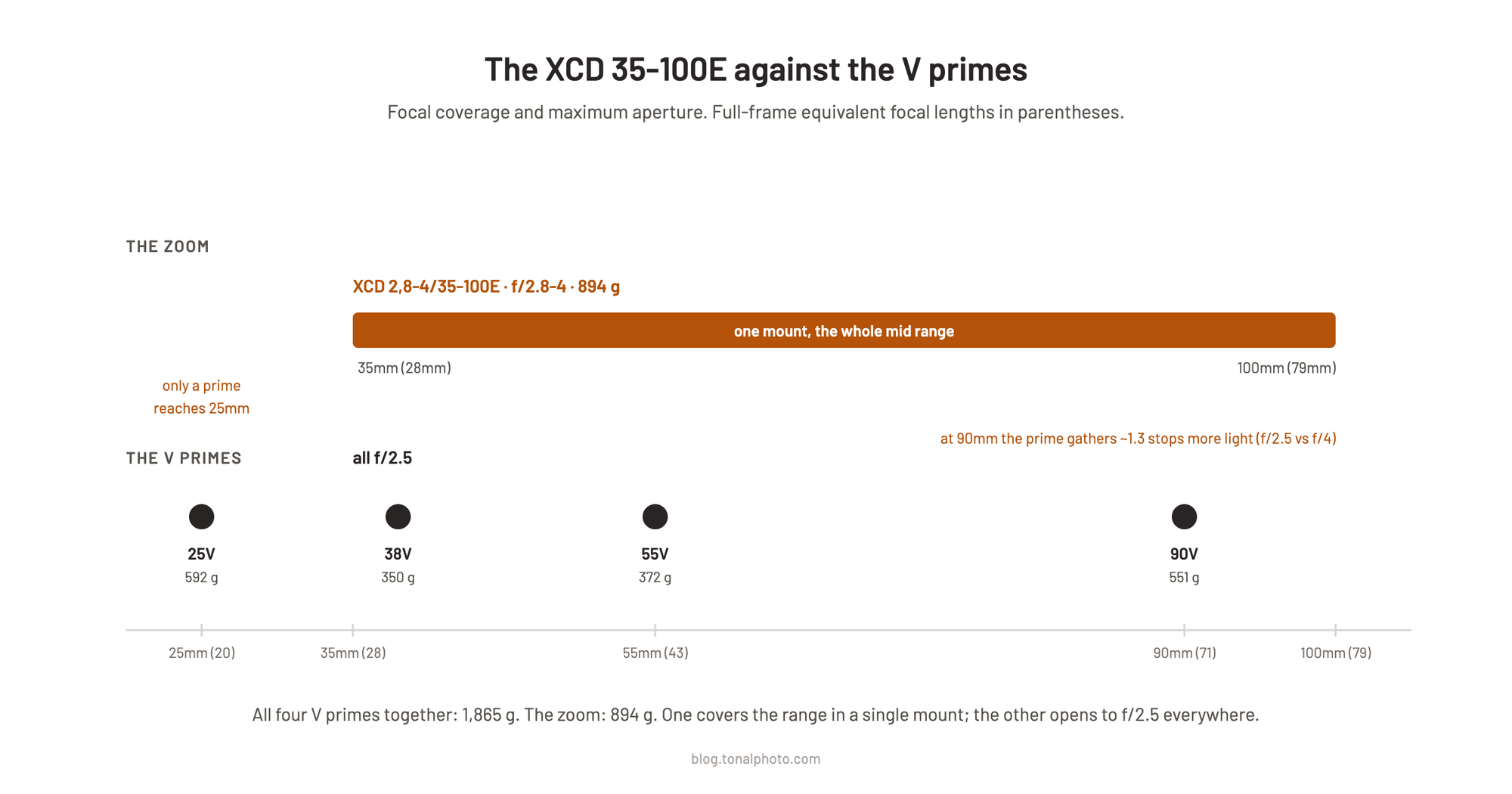
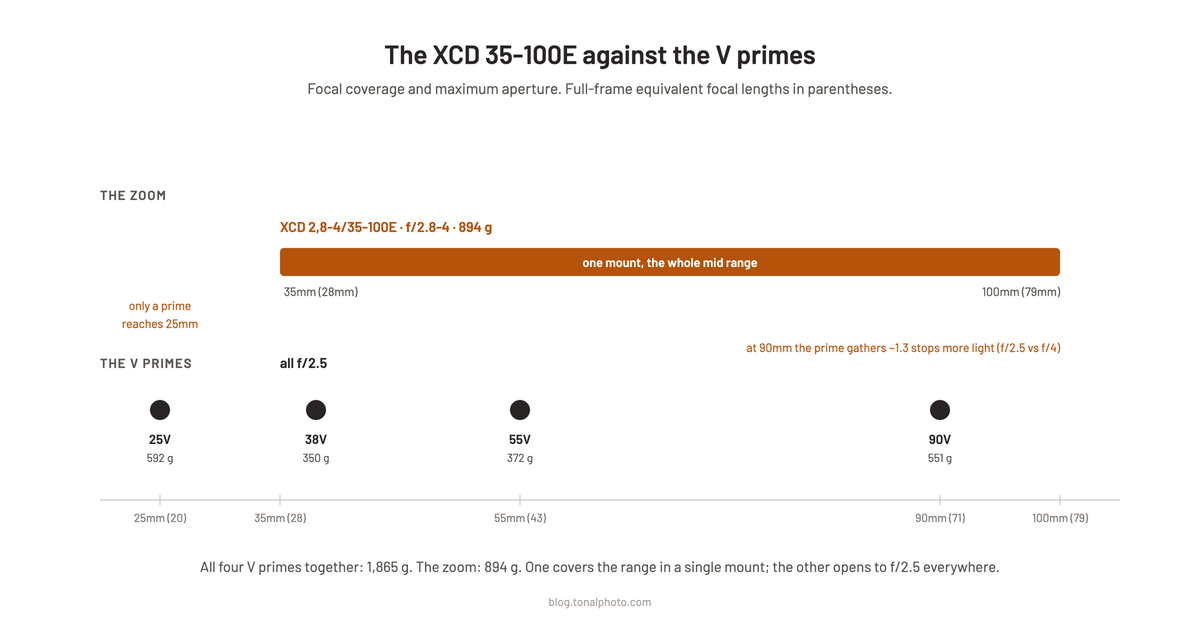
Figure 1: One mount covering the whole mid range, or four lenses that open to f/2.5. All figures from the XCD lens guide.
What does the 35-100E get right?
Almost everything. This is the part both camps agree on more than the forum arguments suggest: the 35-100E is an excellent lens, full stop. One commenter called it "a zoom full of quality primes,"¹ and having shot one for months, I would not argue with that. The focal range covers the entire mid band a landscape or travel photographer lives in, 28mm to 79mm in full-frame terms. Put it on the camera in the morning and there is a real chance you never take it off.
The one-mount argument goes beyond convenience. Every lens swap in the field is a dust opportunity on a 100-megapixel sensor, and skipping swaps entirely is a legitimate reason to own this lens. The weight math surprises people too: the zoom's 894 g sounds heavy until you notice that carrying all four V primes costs 1,865 g plus the bag space, and even a two-prime kit lands within shouting distance of the zoom once you add the second lens.
It also does things no single prime in its range can. Its 1:4 close-focus at the 100mm end is the best near-macro capability in the system outside the 120 Macro itself, genuinely useful for the casual close-ups landscape shooters run into. And unlike its sibling, the 20-35E, it supports continuous autofocus and carries the control ring from the V series.
Have you seen the guide? I've published Essential Phocus 4.x for Mac - 85 topics across 8 sections and 251 pages covering everything from HNCS color science to HDR workflows. It's the reference manual Hasselblad hasn't updated since 3.8. It's $49, and updates are included.
The case for the primes is light, not sharpness
If you came here expecting "primes are sharper," I have better news and worse news. At overlapping focal lengths and equal apertures the rendering is close, close enough that in a blind test I would not bet on telling my 55V frames from my 35-100E frames at 55mm. The forum debate on long-end sharpness runs both directions, some owners reporting softness in the 70-100mm range on the 100-megapixel sensors and others pointing at MTF data to argue parity,² and my own copies never settled the question for me. Sharpness is the wrong hill for the prime argument to die on. For one V prime at least there is now a number to argue with instead of a copy-to-copy impression: the XCD 25V diffraction test measures the sharpness curve stop by stop.
The real difference for me is one and a third stops. The zoom gives you f/2.8 at its wide end and f/4 by the long end; every V prime opens to f/2.5, everywhere. At 90mm that gap is the difference between ISO 800 and ISO 2000 in the same fading light, or between a shutter speed that freezes leaves and one that does not. Italy is where that stopped being hypothetical for me: evening light in narrow streets, interiors, blue hour, all the light my kind of shooting actually happens in, and the zoom's f/4 long end kept asking my ISO to cover for it. Medium format compounds the aperture gap in a second way: f/2.5 on an XCD lens renders depth of field roughly like f/2 on full frame, so the primes are also buying subject separation the zoom cannot reach.
There are smaller cases too. The primes share 72mm filters; the zoom's unusual 86mm thread means a second, more expensive set of polarizers and NDs, chosen from a thinner field, since not all the popular filter vendors make an 86mm and even fewer of the quality magnetic mount systems do. The 25V goes wider than the zoom ever will. And a single prime on the body is a smaller, lighter, less conspicuous package than the zoom for street and city work.

Which should you buy: the 35-100E or the primes?
Where your photographs happen decides this, not which lens wins on paper.
If your light is generous, buy the zoom. Daylight landscapes, travel in open country, anything on a tripod where shutter speed is free: the 35-100E covers all of it in one mount with optics you will not outgrow. This is also the answer if you loathe changing lenses in the field, and it is the cheaper answer, since the zoom costs less than any two of the primes.
If your light is scarce, buy primes. Blue hour, interiors, forests under canopy, handheld work at the edge of usable shutter speeds: f/2.5 everywhere is worth more than focal-length convenience, and no zoom setting substitutes for light you did not capture.
If you are bridging a gap in a prime kit, the real comparison is the 35-100E against the 55V alone, not against the whole prime lineup. The zoom wins on flexibility; the 55V wins on speed, size, and sharing your existing 72mm filters. I went the 55V route the second time around, but I shoot a lot of my work in low-light conditions. A gap-bridger who mostly shoots daylight should probably take the zoom.
The threads will keep reappearing regardless of what I decided in Italy, because the next person asking has different light than either of us. If the numbers matter more than my opinion, the full spec tables for every XCD lens are in the lens guide, sorted the same way as the table above.
References
- r/hasselblad, "Help me bridge the gap: 35-100mm Zoom or the 55V Prime?" - representative thread of the recurring question, including the "zoom full of quality primes" assessment.
- r/hasselblad, "35-100e vs 38v, looking for input and opinions" - the long-end sharpness debate argued in both directions.
- Hasselblad, XCD 2,8-4/35-100E product page - official specifications.