The Hasselblad X2D II's 43.8 x 32.9 mm sensor has a crop factor of 0.79 relative to 36 x 24 mm full frame. Multiply the f-stop set on the X2D II by 0.79 to get the full-frame f-stop with the same depth of field: f/8 on the X2D II looks like f/6.3 on full frame. To match a full-frame shooter at f/8, divide instead and set f/10 (f/9.5 if the camera is on half stops). Exposure does not change. f/8 is f/8 on both.
That is the whole rule. The tables below run it for every common f-stop and for five medium format sizes, the calculator does the arithmetic for any value, and the two diagrams show why a smaller number comes out of a bigger sensor. The physics, the circle of confusion, and what diffraction does to all of this at 100 megapixels live in the longer aperture and equivalence page.
Key finding: Full-frame equivalent f-stop = marked f-stop x crop factor. The X2D II, X2D 100C and 907X with the CFV 100C share the same 43.8 x 32.9 mm sensor and a 0.79 crop factor. The conversion covers depth of field and background blur only. Exposure is unchanged.
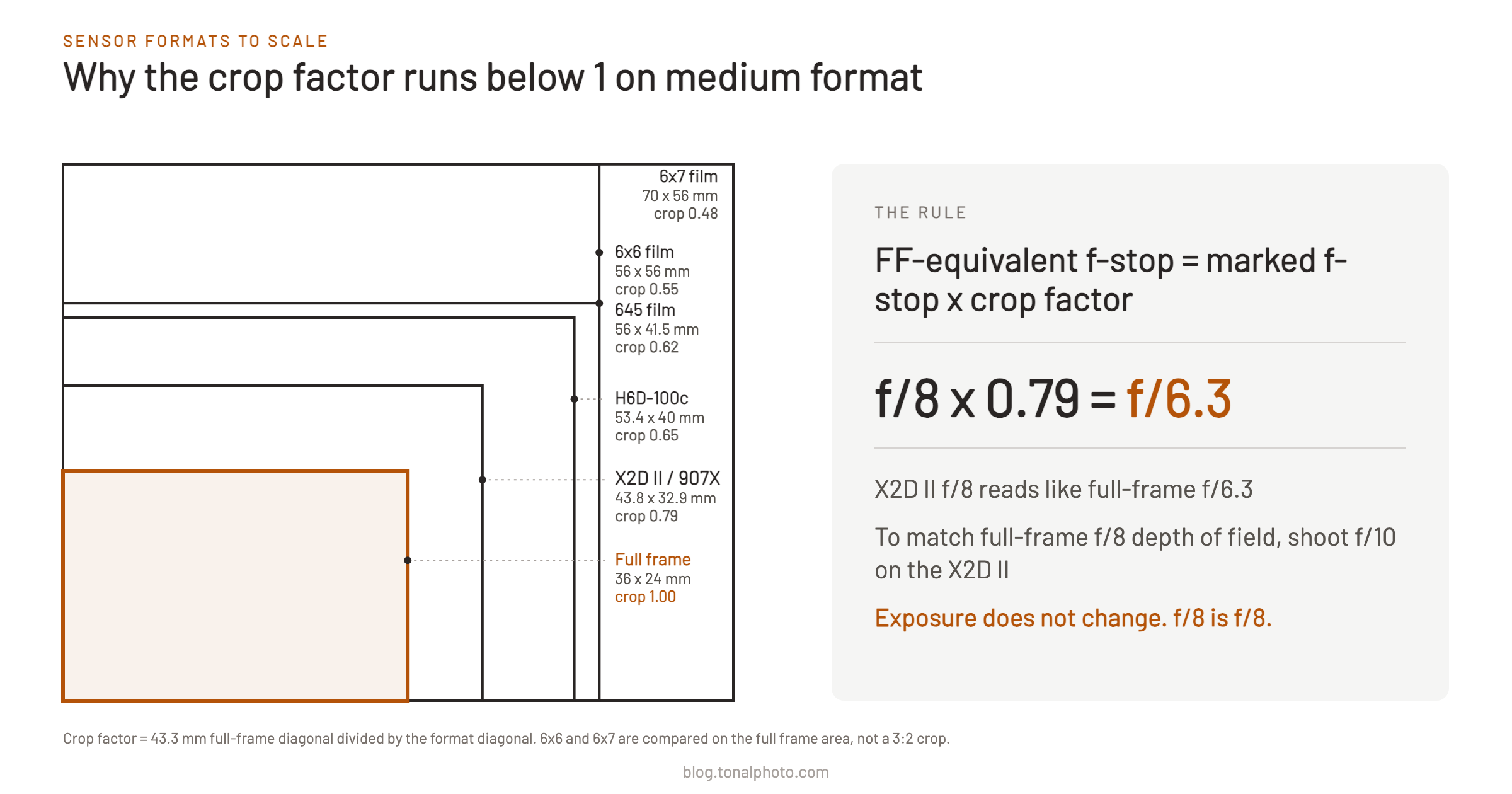
Medium Format Crop Factor Chart
The crop factor is the full-frame diagonal (43.3 mm) divided by the format's diagonal. For the 43.8 x 32.9 mm sensor in the X2D II, X2D 100C, and the 907X with the CFV 100C, that is 43.3 / 54.8 = 0.79. APS-C and Micro Four Thirds shooters are used to crop factors above 1, and the arithmetic is the same here with the factor below 1.
| Format | Frame (mm) | Diagonal (mm) | Crop factor | Area vs full frame |
|---|---|---|---|---|
| Full frame | 36 x 24 | 43.3 | 1.00 | 1.00x |
| Hasselblad X2D II, X2D 100C, 907X and CFV 100C | 43.8 x 32.9 | 54.8 | 0.79 | 1.67x |
| Hasselblad H6D-100c | 53.4 x 40 | 66.7 | 0.65 | 2.47x |
| 645 film (nominal) | 56 x 41.5 | 69.7 | 0.62 | 2.69x |
| 6x6 film (nominal) | 56 x 56 | 79.2 | 0.55 | 3.63x |
| 6x7 film (nominal) | 56 x 70 | 89.6 | 0.48 | 4.54x |
Hasselblad's own datasheet quotes 0.78 as the focal-length multiplier for the X2D II.¹ The diagonal ratio of the sensor dimensions on the same datasheet is 0.790, and I do not know how Hasselblad arrived at 0.78. Running the tables below with 0.78 instead of 0.79 changes no entry in the X2D II columns. Film frame sizes are the nominal 120 gate sizes;³ individual cameras vary by a millimetre or so, which also changes nothing at third-stop resolution.
The 6x6 and 6x7 rows need a caveat. Their aspect ratios are square and 5:4, so a diagonal comparison against 3:2 full frame assumes you use the whole frame. If you crop a 6x6 negative to 3:2 you are using a 56 x 37 mm area, and the crop factor becomes 0.64, close to the 645 row. Pick the row that matches the frame you print.
The same factor converts focal lengths. An XCD 55V frames like a 43 mm lens on full frame, and the XCD lens guide lists the equivalent for every current lens.
Researching and writing the blog and page posts I produce takes up a lot of my time and costs me money for software subscriptions, tooling, and other incidentals related to running a business.
Please consider a paid membership to help me keep the lights on and pay the bills - it is only a fraction of the cost of an X2D II and a lens. Click on the button to go to the membership page to see the options available.
Full Frame to Medium Format F-Stop Conversion Table
Read Table 2 when you know the f-stop on the medium format camera and want to know what depth of field a full-frame shooter would recognise. Read Table 3 when a full-frame shooter next to you is at a given f-stop and you want to match their depth of field.
| Set on camera | X2D II / 907X (x0.79) | H6D-100c (x0.65) | 645 (x0.62) | 6x6 (x0.55) | 6x7 (x0.48) |
|---|---|---|---|---|---|
| f/2.8 | f/2.2 | f/1.8 | f/1.8 | f/1.6 | f/1.4 |
| f/4 | f/3.2 | f/2.5 | f/2.5 | f/2.2 | f/2 |
| f/5.6 | f/4.5 | f/3.5 | f/3.5 | f/3.2 | f/2.8 |
| f/8 | f/6.3 | f/5 | f/5 | f/4.5 | f/4 |
| f/11 | f/9 | f/7.1 | f/7.1 | f/6.3 | f/5 |
| f/16 | f/13 | f/10 | f/10 | f/9 | f/8 |
| f/22 | f/18 | f/14 | f/14 | f/13 | f/11 |
| f/32 | f/25 | f/20 | f/20 | f/18 | f/16 |
The XCD V-series primes open to f/2.5. On the X2D II that gives the depth of field of f/2 on full frame, which is the number to keep in mind when a full-frame portrait shooter talks about f/2 on a 50 mm.
| Full frame shooter is at | Set X2D II / 907X to | Set H6D-100c to | Set 645 to | Set 6x6 to | Set 6x7 to |
|---|---|---|---|---|---|
| f/2 | f/2.5 | f/3.2 | f/3.2 | f/3.5 | f/4 |
| f/2.8 | f/3.5 | f/4.5 | f/4.5 | f/5 | f/5.6 |
| f/4 | f/5 | f/6.3 | f/6.3 | f/7.1 | f/8 |
| f/5.6 | f/7.1 | f/9 | f/9 | f/10 | f/11 |
| f/8 | f/10 | f/13 | f/13 | f/14 | f/16 |
| f/11 | f/14 | f/16 | f/18 | f/20 | f/22 |
| f/16 | f/20 | f/25 | f/25 | f/29 | f/32 |
| f/22 | f/29 | f/32 | f/36 | f/40 | f/45 |
Table 3 is the one that answers the question as it is usually asked. A full-frame landscape shooter at f/8 matches f/10 on the X2D II in third stops, f/9.5 in half stops. Their f/11 matches f/14. That is where diffraction starts to cost on a 100 MP sensor: on the XCD 25V, measured sharpness is at 86% of peak by f/11 and 72% by f/16, so matching a full-frame f/16 landscape at f/20 is a real trade.
Equivalent Aperture Calculator
Equivalent aperture calculator
Depth of field and background blur only. Exposure does not change: set the f-stop the meter asks for.
The calculator rounds to the nearest third stop and the nearest half stop, because the X2D II can be set to either. The exact value is shown alongside for anyone who wants to carry the decimals.
Have you seen the guide? I've published Essential Phocus 4.x for Mac - 85 topics across 8 sections and 251 pages covering everything from HNCS color science to HDR workflows. It's the reference manual Hasselblad hasn't updated since 3.8. It's $49, and updates are included.
How the Equivalent F-Stop Is Calculated
Aperture diameter is focal length divided by f-number. To frame the same scene from the same spot, the 44 x 33 sensor needs a longer lens than full frame: 63 mm on the X2D II matches the view of 50 mm on full frame. At f/8 the 63 mm lens opens a 7.9 mm hole and the 50 mm lens opens a 6.25 mm hole. The bigger hole sends a wider cone of light to the sensor, and a wider cone makes a bigger blur disk for the same amount of defocus. Bigger blur disks at the same print size mean shallower depth of field.
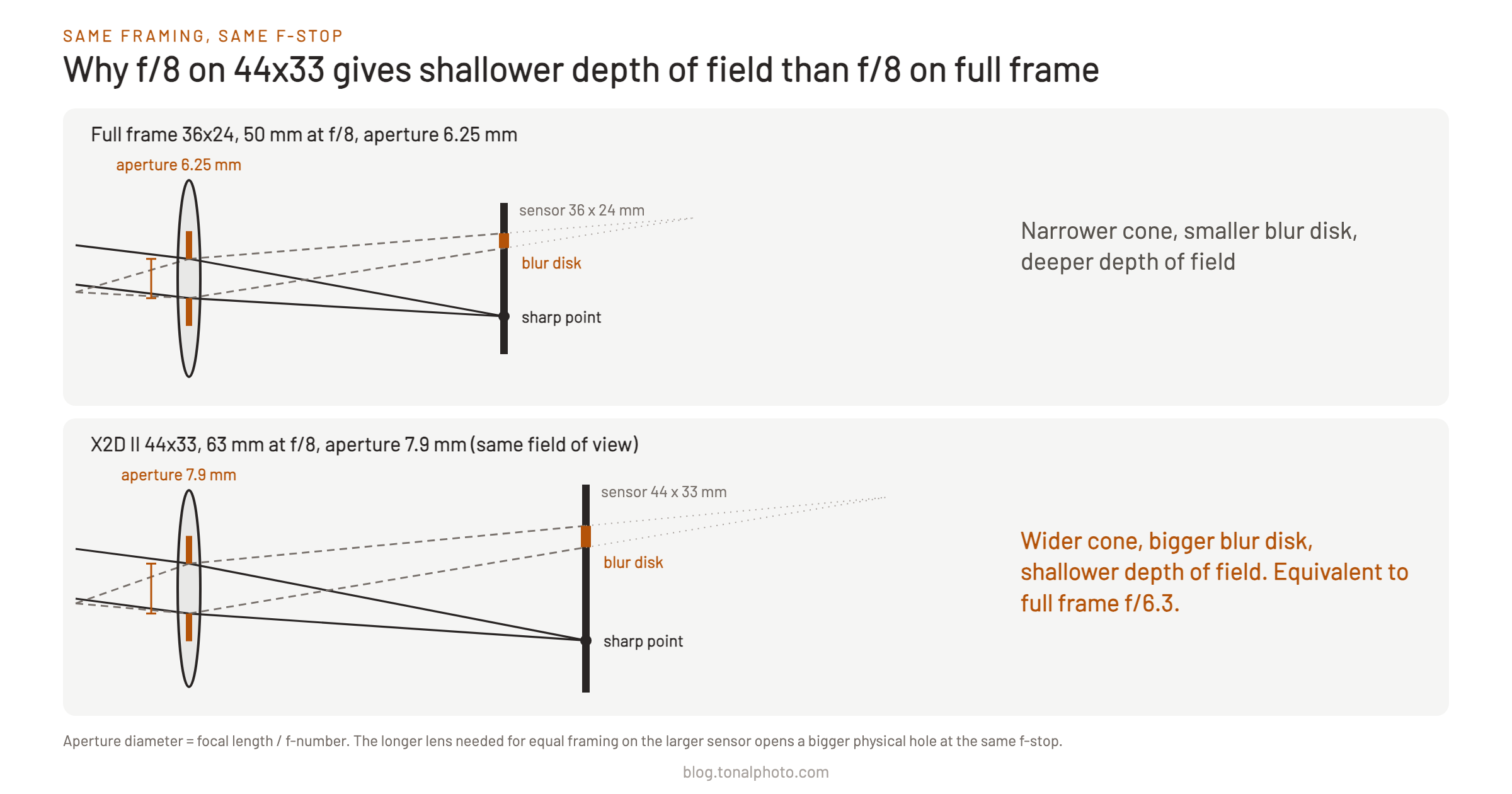
Multiplying the f-number by the crop factor is the shortcut for that geometry. It holds at any focal length as long as the framing matches, and it is the same arithmetic whether you are converting from 44 x 33 or from a 6x7 negative.
Does Medium Format Change Exposure?
No. The f-number describes light intensity per unit of sensor area, and that is the same on every format. If the meter says f/8 at 1/250 s and ISO 100, that is the exposure on full frame, on the X2D II, and on a Pentax 67. When you stop down from f/8 to f/10 to match a full-frame friend's depth of field, you give up two-thirds of a stop of light (half a stop if you land on f/9.5) and make it up with shutter speed or ISO, exactly as you would on any camera.
The larger sensor still collects more total light at the same exposure, because the same intensity falls on 1.67 times the area. That is where the cleaner shadows and smoother gradation at base ISO come from, and it is a separate fact from the depth of field conversion. Convert f-stops for depth of field. Meter f-stops as marked.
Using the Chart in the Field
The practical version fits on one line. Set the f-stop you would have used on full frame, then go one click narrower in half stops or two clicks narrower in third stops. At f/8 that lands on f/9.5 or f/10. At f/5.6 it lands on f/6.7 or f/7.1. The depth of field matches and the exposure is half a stop or two-thirds of a stop down, which the camera handles.
Going the other way, if you are reading a full-frame tutorial that says shoot wide open at f/1.8 for subject separation, the X2D II would need f/2.2 to match it. The V primes stop at f/2.5, which lands at full-frame f/2 and falls just short of what the tutorial intends.
Sensor and frame dimensions checked against the sources in the references on 11 October 2026.
References
- Hasselblad side-by-side comparison: X2D II 100C, X2D 100C, 907X & CFV 100C (sensor dimensions 43.8 x 32.9 mm); the 0.78 focal-length multiplier is from Hasselblad's X2D II 100C datasheet PDF
- Hasselblad H6D-100c, B&H product listing (sensor 53.4 x 40.0 mm)
- 120 film, Wikipedia (nominal 6x4.5, 6x6 and 6x7 frame sizes)
- Aperture, Equivalence, and Diffraction on Medium Format, the long-form treatment this page summarises