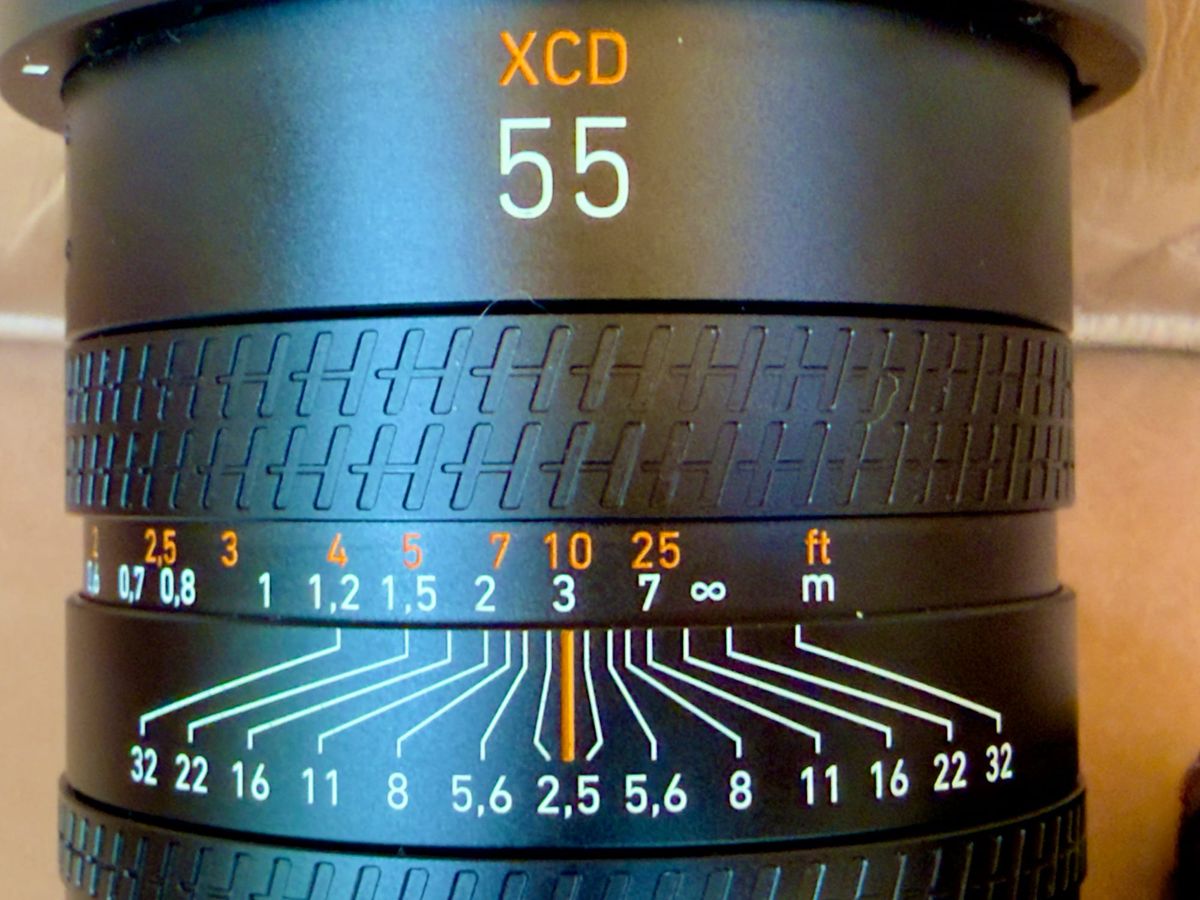
Your camera knows exactly where you focused. It has to: autofocus is exactly the act of measuring and moving until the subject is sharp. On July 2, 2026, Capture One and Hasselblad announced a partnership letting Capture One open Hasselblad RAW files natively for the first time, and buried in the release notes was a claim that Hasselblad files carry no focus-distance information for lens corrections. That left a question I could not let go of: does the X2D II write that number down?
The short answer is yes, quietly, since a firmware update last November. The longer answer involves a claim in Capture One's release notes, three test frames shot at marked lens distances, a number that came back almost exactly right, and a doctored test file that fooled me for an afternoon.
Key finding: Every 3FR from an X2D II on firmware 1.2.7.11 or later (November 27, 2025) records data from which real focus distance can be recovered. Focused at the 3 m barrel mark, the file works out to 2.99 m. For eight months no editor read it, and ExifTool could not even parse it. Since firmware 1.3.16.1 (July 16, 2026) the camera also writes the standard EXIF field, and Capture One and Lightroom Classic read it and use it. Phocus corrects for focus distance through Hasselblad's own data instead. The update just below has the tests.
Update: all three editors now correct for focus distance (July 27, 2026)
When I ran this investigation, the focus numbers lived only in Hasselblad's private maker note, and I guessed the future firmware update Capture One mentioned would move them somewhere documented. It has, and it beat me to press: firmware 1.3.16.1, released July 16, 2026, nine days before this post went live, writes focus distance into the standard EXIF SubjectDistance field, the documented tag most cameras use. I reshot the ladder on the new firmware with the 55V. Three frames at increasing distance, and the standard field reads 0.43, 0.51, and 0.61 m, tracking focus and absent from every file the older firmware produced. ExifTool names it now, where before it could only show anonymous numbers.
So I re-ran the doctored-file test against the new field. Same protocol as the original test described below: three copies of one 1.3.16.1 file, identical except for the SubjectDistance bytes, one honest at 0.43 m, one claiming 0.61 m, one claiming 50 m, every edit verified by full-file byte comparison, every export checked against a same-file rerun control.
This time the null broke, in both editors. Lightroom Classic 15.4.1 produced three measurably different renders from bit-identical develop settings, and the size of the difference grows with the distance gap, which is what a correction interpolated by focus distance looks like. Capture One 16.8.4 was blunter: the copy claiming 50 m came back at different pixel dimensions than the close-focus copies, 8742 by 11656 pixels against 8519 by 11359, consistent with a distortion correction that crops less when it believes the subject is far away. Two bytes changed in the file, and the output geometry changed with them. One caveat: Capture One rendered 0.43 m and 0.61 m identically within its own render noise, so its response may be coarse at close range.
Phocus needed a different instrument. Metadata edits cannot probe it cleanly (a session quirk documented in the test-data appendix), so I ran an optical test instead: the same evenly lit wall shot at 0.45 m, at 3 m, and at infinity, each frame rendered with lens corrections on and off, and the on-to-off ratio compared across distances. The corrections came back measurably different at each distance, largest between close focus and infinity, in the direction optics predicts, and every duplicate export was bit-identical, so this is not render noise. The standard field cannot be the source either: beyond close range the camera writes no real value there. Phocus corrects for focus distance through Hasselblad's own data channel. The per-shot data it needs has been in every file since last November; when Phocus started using it I cannot say, but version 4.2.1 uses it today.
This post originally ran under the title "No Editor I Tested Reads It," and that claim is now history; the title above has been changed to match reality. All three editors demonstrably correct for focus distance today: Capture One and Lightroom Classic by reading the new standard field (neither displays it anywhere, and neither mentioned it in release notes; the corrections just changed under everyone's feet), Phocus through Hasselblad's private data. Two caveats keep the scoreboard honest. The camera writes a real value into the standard field only at close focus: my frames below 0.6 m all carry one, while by 3 m it records the infinity placeholder instead, so Capture One and Lightroom benefit exactly where distance matters most for corrections. And files shot before firmware 1.3.16.1 carry only the private fields, which those two apps still ignore, so there is no retroactive benefit in either; Phocus is the only editor whose route does not depend on the new firmware.
Why Your Software Wants to Know Where You Focused
A lens does not behave the same at every focus setting. Focus a 55mm close and it behaves measurably differently than the same glass at infinity: distortion shifts, chromatic aberration changes, and in many designs the focal length itself drifts as elements move inside the barrel, the difference sharpest in close work.¹ That is why serious correction engines are built around focus distance, not just lens identity. Adobe's lens profiles are constructed from test shots at combinations of focal length, aperture, and focus distance.² DxO calibrates its modules the same way, since distortion depends "firstly on the focal length" and "secondly on the focus distance."³ Canon, Nikon, Olympus, and Panasonic all cooperate by writing some version of that distance into their RAW metadata.⁴
Which brings us to the line in Capture One's 16.8.3 release notes that started this investigation. Explaining why its brand-new Hasselblad support applies a default lens correction rather than a precise one, Capture One wrote that the RAW file "doesn't contain this information," with a fix waiting on a future Hasselblad firmware update.⁵ That sentence sounded final. It also turned out to be more complicated than it looks.
Researching and writing the blog and page posts I produce takes up a lot of my time and costs me money for software subscriptions, tooling, and other incidentals related to running a business.
Please consider a paid membership to help me keep the lights on and pay the bills - it is only a fraction of the cost of an X2D II and a lens. Click on the button to go to the membership page to see the options available.
What I Found Inside the Files
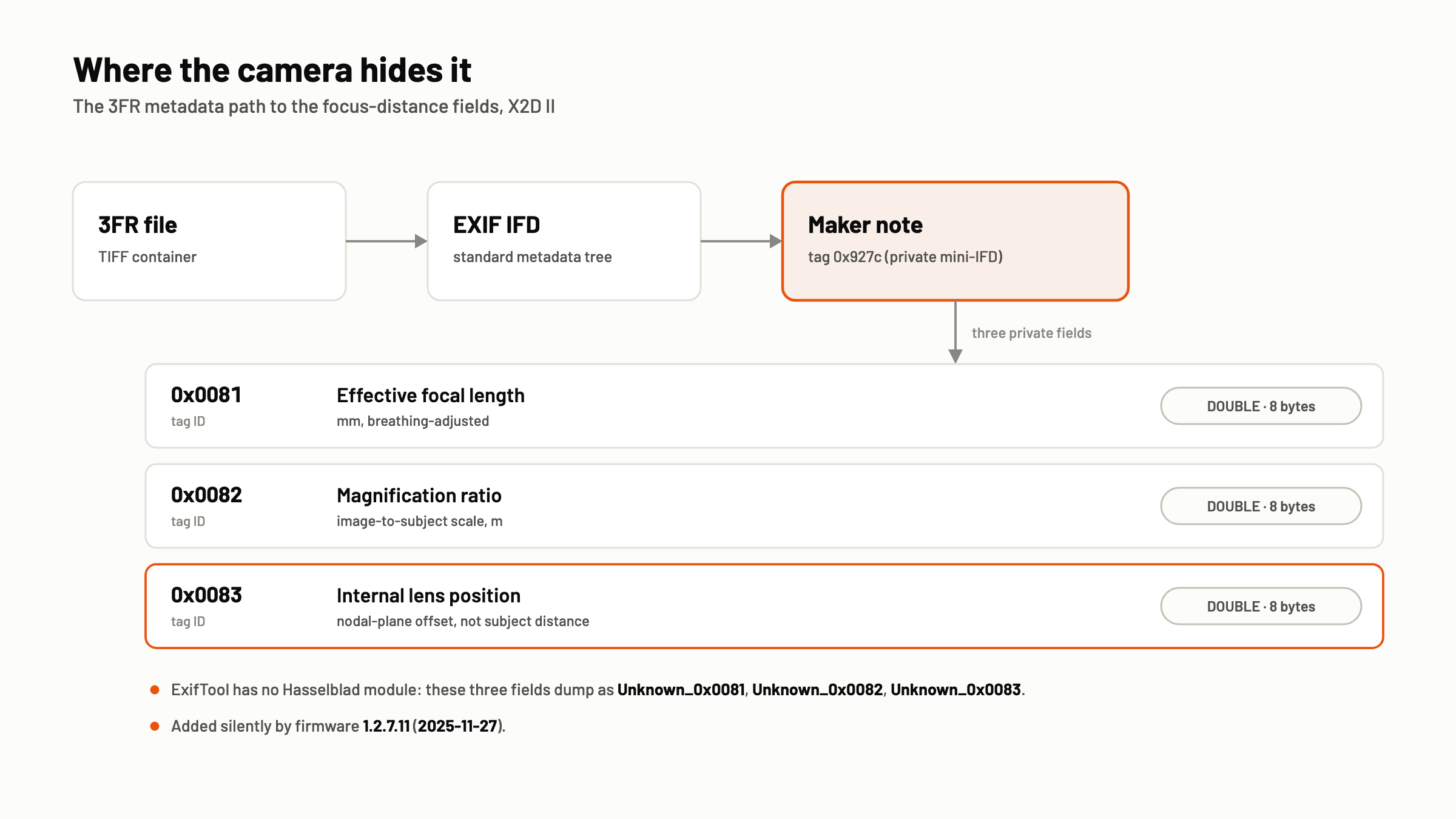
I compared the metadata of two of my own 3FR files: one shot in November 2025, one shot in June 2026. The June file contains three numbers the November file simply does not have, added without a word in any release note by firmware 1.2.7.11, whose official changelog talks about shutter sounds and rating modes, not metadata.⁶
Those three numbers appear to belong to the image stabilization system: to steady a shot properly, IBIS needs to know how the lens is focused, since the closer you focus, the more the image shifts for the same wobble of your hands. Read together, they describe the lens's focus state at capture: the effective focal length right now (which drifts as you focus, the behavior photographers call focus breathing), the magnification, and an internal measure of the optics' position.
Two of those numbers, focal length and magnification, are all you need. A formula that has lived in optics textbooks for two centuries turns them into the distance you focused at.⁷
The Test: Three Frames at Marked Distances
Claims like this need substantiation. Three frames with the XCD 2,5/55V, all at f/8, focused at three of the distances the barrel marks: 1.5 m, 3 m, and infinity.
| Focused at (barrel mark) | Focal length in file | Magnification in file | Distance calculated |
|---|---|---|---|
| 1.5 m | 54.6 mm | 0.041 | 1.38 m |
| 3 m | 55.7 mm | 0.019 | 2.99 m |
| Infinity | 56.6 mm | 0.000 exactly | Infinity |
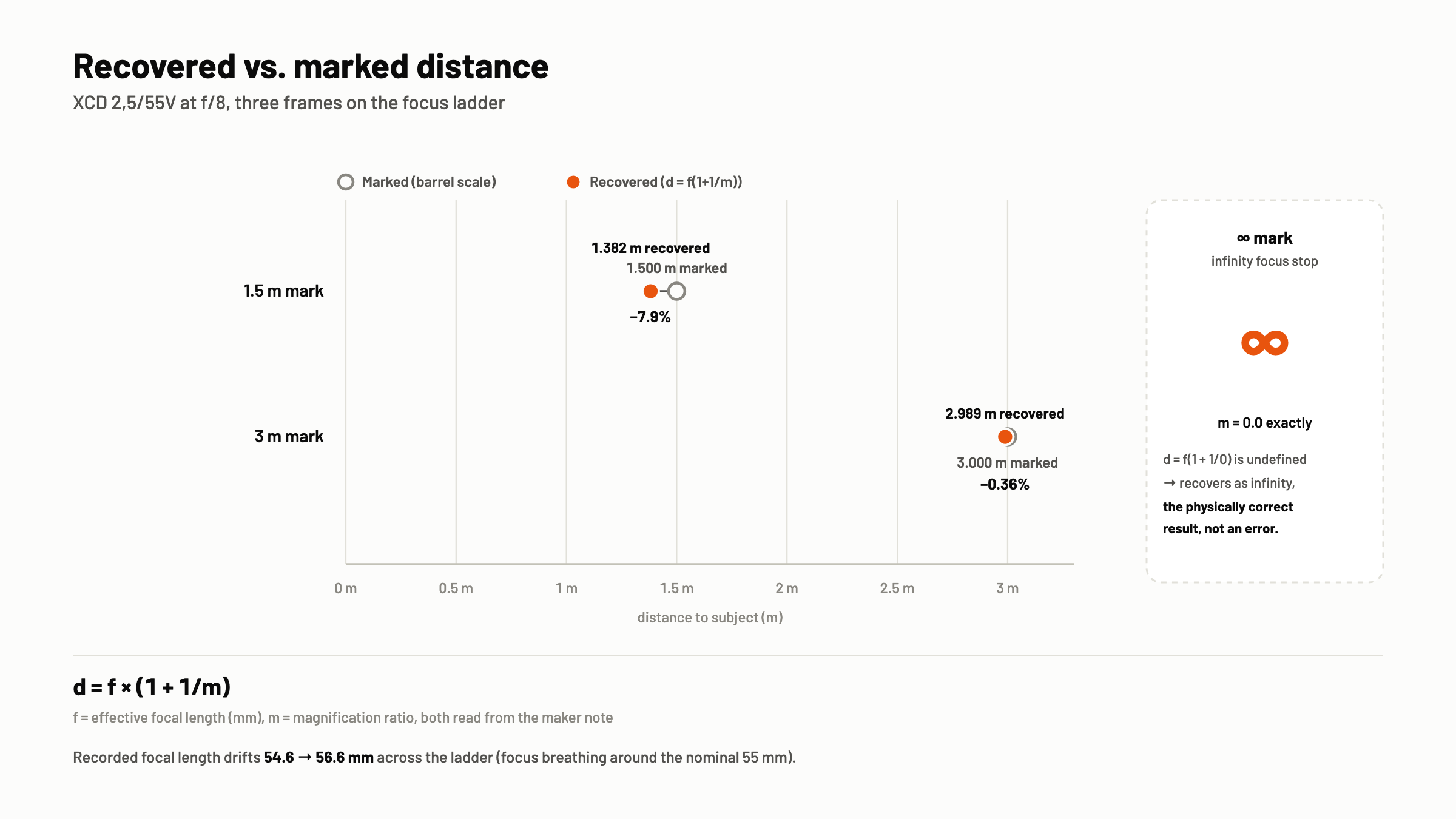
The 3 m frame came back at 2.99 m, a third of one percent off the mark. The 1.5 m frame landed at 1.38 m, further off but in the direction close-focus optics predict, and barrel markings are themselves approximate. The quiet showstopper is infinity: recorded magnification isn't "very small," it's exactly zero, the mathematically correct value for infinity focus. (Full arithmetic in the test-data appendix.)
These are not numbers that happen to correlate with focus distance. They are focus distance, wearing a thin disguise.
What Actually Reads These Numbers?
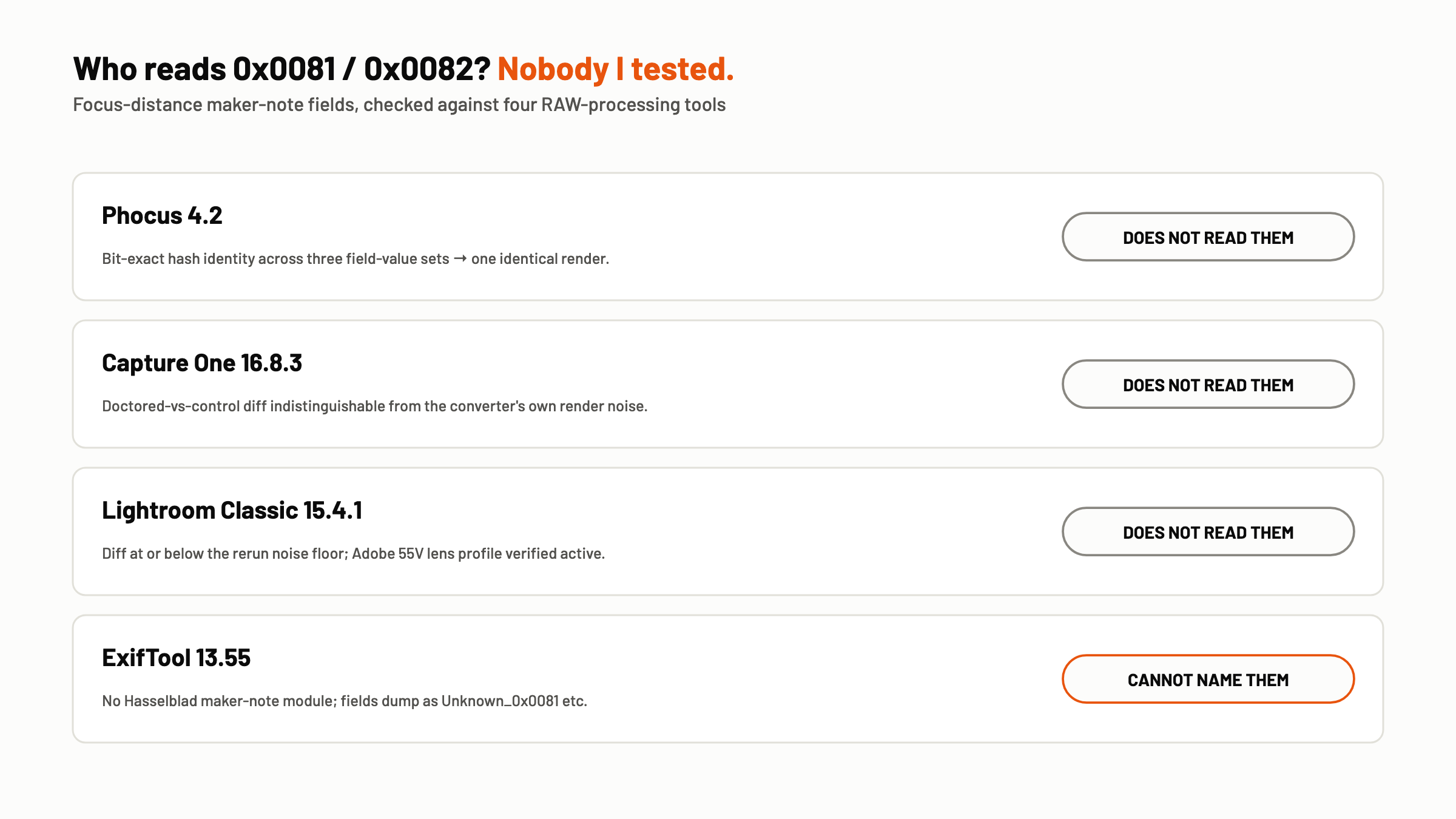
None of the three editors I tested reads these fields. The proof is a doctored file built to fool at least one of them, and it very nearly did.
I ran the bluntest experiment I could think of: byte-identical copies of the 3 m test file, differing only in the recorded focus numbers (one doctored to claim an extreme close-up), each exported with untouched default settings and checked against a same-file rerun to establish each converter's own render-to-render noise floor.⁸ If an editor's lens correction responded to those numbers, the copies would render differently by more than that floor.
Phocus fooled me for an afternoon. My first pass showed the doctored copy rendering visibly different, vignetting off, white balance shifted, and for a while it looked like Hasselblad's own software was reading these numbers after all. It wasn't: a stray setting had attached itself to one file in that session, not the metadata, and a clean rerun with fresh copies rendered identically no matter what focus numbers each file carried. Phocus ignores these fields too. The lesson I keep relearning: one test is never enough. Full protocol and hashes are on the test-data appendix.
Capture One 16.8.3 rendered both copies identically, within its own render-to-render noise, exactly what its release notes imply. Lightroom Classic did the same, with Adobe's own 55V profile confirmed active on every export via embedded develop settings. ExifTool has no Hasselblad module at all and shows the fields as anonymous, unnamed numbers. Three editors, three confirmations: nobody reads the private maker-note data.
Was Capture One Wrong?
Not in any way that matters. My render test backs Capture One up on its own behavior: it does exactly what its documentation says it does. The numbers exist in the file, but in a private, undocumented corner of Hasselblad's metadata, with no public specification, no field names, no guarantee they mean the same thing after the next firmware update. No vendor can build corrections on numbers like that. "The file doesn't contain this information" is misstated rather than false, and the promised firmware update turned out to do exactly what I guessed: move the number from an unlabeled drawer to a documented shelf (see the update above).
What the finding does change is the timeline. Hasselblad didn't start solving this problem when the Capture One partnership was announced on July 2. The camera has been writing down focus state since November. The plumbing came first; the partnership announcement described the faucet.
What This Means for Your Photographs
This section originally said: nothing changes, and nothing needs doing, because those corrections were tuned per lens but blind to distance.¹ That was true of the firmware I tested, and already out of date the day this post went live. Firmware 1.3.16.1 had landed nine days earlier and changed the answer; the update above sets the record straight. The practical stakes are where they always were, with close-focus shooters: macro, product, tight portraits, foreground-heavy landscapes are where distance handling matters most. At infinity and normal shooting distances the difference is negligible.
Phocus turned out to be the interesting answer. My test proves it doesn't read these two fields, but the camera bakes other per-shot data into the file, and the optical test in the update above shows its corrections are distance-aware anyway: Phocus reads some of that data by its own route.
That future arrived faster than this post expected, and faster than my publishing schedule. Nine days before this post went live, the promised firmware update landed and started writing the distance where any software can find it, and the editors turned out to be reading. The update below has the full test.if third-party software starts consuming focus distance properly, corrections should improve most exactly where they're currently weakest. And because the X2D II has already been recording focus state for eight months, some files you've already shot could benefit retroactively.
That retroactive fix now exists as a free tool: The Data Was Always in Your Older X2D II Files.
Focus distance is not the only field the camera writes that software ignores. In-camera star ratings get the same treatment, and Appaloosa repairs those.
I haven't tested whether the X2D 100C or CFV 100C write the same fields, since I don't own either; if you shoot one and want to look, the firmware changelog post covers how the X2D II versions map, and I'd like to know what you find. The color comparison I promised in the Capture One post, Phocus versus Capture One versus Lightroom on identical files with measured differences, is on my ToDo list.
References
- Things You Should Know About Your Lenses, But May Not - Roger Cicala, LensRentals, on close-focus performance, floating elements, and focal length change with focus
- Adobe Lens Profile Creator User Guide - Adobe's profiles are built from calibration sets at fixed focal length, aperture, and focus distance
- Geometric Lens Distortion: How DxO corrects optical flaws - DxO on distortion's dependence on focal length and focus distance
- ExifTool Tag Names index - per-brand maker-note documentation (Canon FocusDistanceUpper/Lower, Nikon, Olympus, Panasonic focus-distance tags; no Hasselblad module exists)
- Capture One 16.8.3 release notes - the lens correction paragraph: default correction applied because the file "doesn't contain this information," pending future Hasselblad firmware
- Hasselblad X2D II Firmware Updates Since Launch - the running changelog; firmware 1.2.7.11's public notes make no mention of new metadata
- For the technically curious: distance = focal length × (1 + 1/magnification), the thin-lens magnification relation. In the test files the fields live in Hasselblad's private maker note as 8-byte floating point values (tags 0x0081, effective focal length in mm, and 0x0082, magnification); a third field (0x0083) tracks internal lens position. Values verified by controlled capture; the mapping to Hasselblad's internal field names is inferred from firmware analysis and flagged as such.
- Behavioral test methodology in brief: copies of the same 3FR differing only in the focus-distance fields (a 16-byte edit, verified with a full-file byte comparison), each exported to 16-bit TIFF with untouched default settings, compared against a same-file rerun control to establish each editor's own render-to-render noise. The full test-data appendix (exact field values, ExifTool dumps, every hash, and the per-editor pixel-difference numbers) is published here: test-data appendix.